Charity Budget Template Funders Trust (Free Download)
A grant application budget is judged on realism and clarity as much as the total amount requested, so funders expect separate project and organisational cost lines rather than one lump sum. Salaries need on-costs added on top of gross pay, such as employer's National Insurance and pension contributions, and overheads should be apportioned using a stated, defensible method rather than a vague 'admin fee'. Assessors reject budgets quickly when they spot round numbers, missing on-costs or figures that don't reconcile.
Download the template
Plenty of what small charities believe about grant budgets is outdated or over-cautious: overheads look greedy, round totals look tidy, the smallest possible ask wins. I read hundreds of funder pages while building CharityIQ’s grant tools, and the rule turned out simpler — assessors fund budgets that look real. This free charity budget template is built to produce exactly that: a two-tab spreadsheet for grant applications, a Project Budget tab for the funded activity and an Organisational (Core Cost) tab that calculates your full-cost-recovery percentage automatically, so you can apply it to any project in minutes. Grab the download, or use the on-page version below if you just need the structure now.
I prepared the template myself — the same two-tab structure I use for my own charity’s applications, tightened up after seeing what funders actually ask for. Because it’s a living document, we mirror the full template as text here as well as offering it as a spreadsheet, so you can copy the structure into your own budgeting tool without the download. Pair it with our how to write a grant application guide for the narrative sections around this budget, or our grant funding handbook if grant funding itself is newer ground for you.
Get the free spreadsheet. Join the CharityIQ AI grant writer waitlist and we’ll send the downloadable version straight to your inbox, along with early access to AI-assisted budget narratives. Join the waitlist →
Project Budget tab (on-page version)
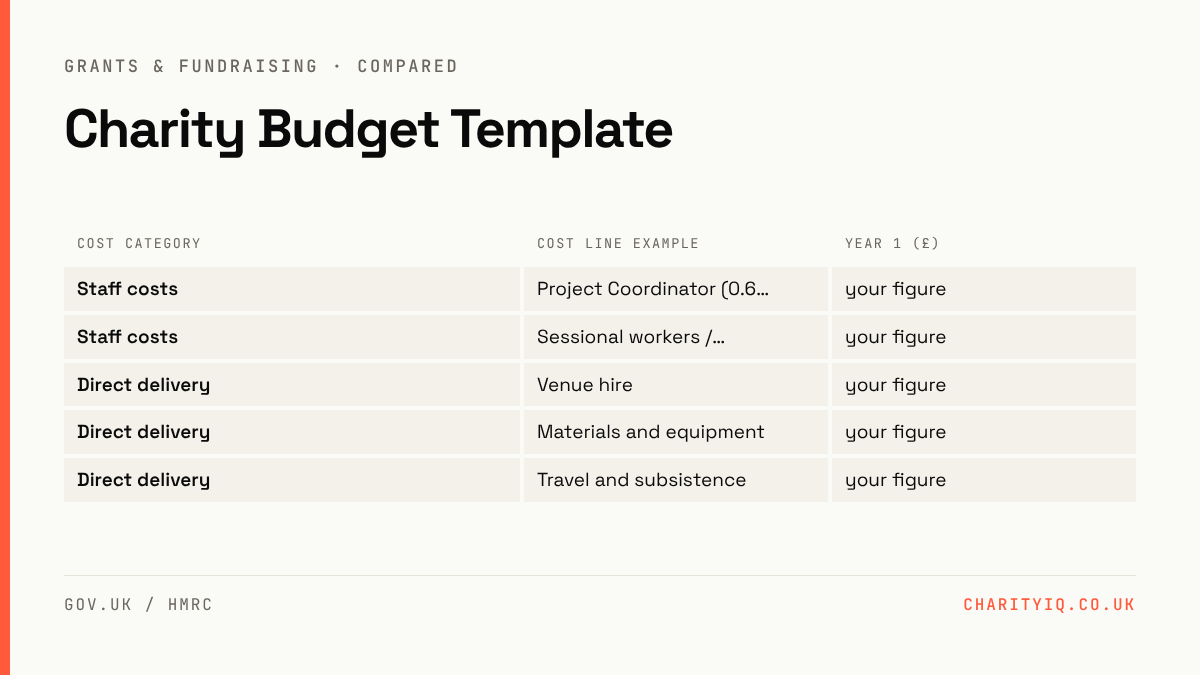
| Cost category | Cost line example | Year 1 (£) | Notes |
|---|---|---|---|
| Staff costs | Project Coordinator (0.6 FTE) | your figure | Gross salary + on-costs, see below |
| Staff costs | Sessional workers / freelance delivery | your figure | Day rate × sessions |
| Direct delivery | Venue hire | your figure | Per session or annual contract |
| Direct delivery | Materials and equipment | your figure | One-off vs. recurring |
| Direct delivery | Travel and subsistence | your figure | HMRC mileage rates where relevant |
| Participant costs | Beneficiary transport / childcare support | your figure | If applicable to your project |
| Monitoring & evaluation | Data collection, evaluation consultant | your figure | Often 5-10% of project cost |
| Overheads | Apportioned core costs | your figure | See “Overheads” section below |
| Total project cost | your total | ||
| Income | This funder’s grant (requested) | your figure | |
| Income | Other confirmed funding | your figure | Name each funder and status |
| Income | Match funding / in-kind | your figure | See “Match funding” section below |
| Total income | total — must equal total cost |
Organisational (Core Cost) tab (on-page version)
| Core cost category | Annual total (£) | % attributable to this project | Amount apportioned (£) |
|---|---|---|---|
| Governance (trustee meetings, audit, insurance) | your figure | your % | annual total × % |
| Finance and HR support | your figure | your % | annual total × % |
| Premises (rent, utilities, IT) | your figure | your % | annual total × % |
| Management and leadership time | your figure | your % | annual total × % |
| Total core costs apportioned | sum of this column |
This structure follows the logic set out in gov.uk’s full-cost-recovery guidance, which recommends charities identify a fair, consistent basis for allocating shared costs to individual projects rather than excluding them altogether. For the full method with worked examples, see our companion piece on full cost recovery for charities, or put your own numbers through our full-cost-recovery calculator to get a defensible percentage without the spreadsheet wrangling.
The cost lines funders expect to see
Funders expect a grant budget to separate staff costs, direct delivery costs, participant costs, monitoring and evaluation, and overheads into distinct lines rather than one bundled figure, because separated lines let an assessor sense-check each cost against the activities described in your narrative. A budget that can’t be traced back to the project description reads as unplanned.
Most funder templates, and certainly the best ones, ask for the same skeleton:
- Staff costs: named or generic roles, FTE or day count, gross pay plus on-costs.
- Direct delivery costs: venue, materials, travel, freelance/sessional fees, anything consumed directly by the activity.
- Participant costs: anything spent to enable beneficiaries to take part, such as transport bursaries or interpreters.
- Monitoring and evaluation: the cost of proving the project worked, including staff time, survey tools or an external evaluator.
- Overheads / core costs: a fair apportionment of your organisation’s running costs, calculated using a stated method, not a flat “10% admin” line invented on the spot.
Every line should map to something an assessor can picture happening. The test I apply to my own charity’s budgets: if I can’t explain a cost in one sentence that mirrors the project narrative, I either cut it or add the sentence that justifies it.
Salaries and on-costs done right
On-costs are the true cost of employing someone above their gross salary, and a grant budget that omits them will run out of money mid-project, so always add employer’s National Insurance, employer pension contributions, and the apprenticeship levy where it applies to every staff line rather than quoting salary alone. On-costs are also the first thing I double-check on my own budgets — easy to forget, expensive to discover missing halfway through a funded year.
A simplified worked example (figures for illustration only, use your own payroll data):
| Item | Approach |
|---|---|
| Gross annual salary | your figure × FTE % |
| Employer’s National Insurance | Current threshold and rate at gov.uk rates and thresholds for employers, check the year you’re budgeting for |
| Employer pension contribution | Minimum auto-enrolment rate, or your scheme’s actual rate if higher |
| Apprenticeship levy | Only if your total UK payroll exceeds the current threshold, see HMRC guidance |
| True cost of post | Gross salary + all of the above |
As a rule of thumb, on-costs typically add somewhere in the range of 15-25% on top of gross salary depending on pension scheme and NI banding, but do not quote this as a fixed figure in a funding application. Check the current percentage against your own payroll provider’s figures or gov.uk rates for the relevant tax year, since National Insurance thresholds and pension minimums change and funders can and do check.
Overheads: apportioning without apology
Overheads belong in a grant budget and funders expect to see them, so apportion them using a consistent, documented method, such as percentage of direct project cost, headcount share, or floor-space share, and state that method in a footnote rather than hiding the figure inside another line.
Three defensible apportionment methods, in order of how commonly funders accept them:
- Percentage of direct costs: total core costs ÷ total direct delivery costs across the organisation, applied consistently to every project. Simplest to explain and audit.
- Headcount basis: core costs divided by number of staff, then multiplied by the FTE working on this project. Works well where most costs are people-driven.
- Floor space or time-use basis: useful where premises costs dominate, e.g. a building-based service.
Whichever method you choose, use the same one across every application in a given year. Funders occasionally compare notes, and an organisation that apportions overheads at 8% to one funder and 20% to another with no explanation looks inconsistent at best.
Don’t apologise for a fair overhead line. A charity that shows its true operating cost is not “overspending on admin,” it is being honest about what delivery actually requires. Under-recovering core costs is a leading cause of organisational financial strain identified across the sector.
From experience: The overhead line is where I slow down when I prepare a grant budget for my own charity — not because it’s the biggest figure, but because it’s the one an assessor is most likely to query. I keep a one-line note of the apportionment method under the table and reuse it every year. A modest figure with a stated method reads as competence; a vague “admin” line invites exactly the question you don’t want.
Match funding and in-kind: how to show them
Match funding and in-kind contributions should appear on the income side of your budget as named, valued lines with a source and status (confirmed, applied for, or pledged), because funders use this section to judge whether your project is realistically resourced beyond their own grant, not to catch you out.
To value and present in-kind support credibly:
- Volunteer time: value at a reasonable hourly rate for the skill involved (not always minimum wage; a qualified trainer’s volunteered time is worth more than general admin help), and note the basis you used.
- Donated goods or venue: use the commercial rate you would otherwise have paid, evidenced by a quote or comparable market rate.
- Staff time from a partner organisation: value using that partner’s actual salary cost, not yours.
- Cash match from other funders: always state whether it is confirmed, pending decision, or still being sought, and update this before every submission. An application listing a funder as “confirmed” when the decision is still pending is one of the fastest ways to lose an assessor’s trust.
When I list other funders on my own charity’s applications, each one carries its honest status — applied for, pending, confirmed — updated the day anything changes. If your organisational strategy leans on flexible income to plug these gaps, our guide to unrestricted funding for UK charities covers how to build and present that buffer.
The 5 budget red flags assessors spot
Grant assessors read hundreds of budgets a year and the same five problems recur constantly: round numbers with no working, missing on-costs, hidden or undisclosed other funders, income and expenditure that don’t add up, and unexplained or unapportioned overheads. Any one of these can move an otherwise strong application into the “query” or “decline” pile.
- Round numbers everywhere. A budget with every line ending in 000 signals estimates rather than costings. Real budgets have odd numbers because real costs are odd.
- Missing on-costs on salaries. Quoting gross salary alone and then finding the project can’t actually afford the person is one of the most common reasons projects run out of money mid-year.
- Undisclosed other funders. Not naming who else you’ve applied to, or listing a funder as confirmed before the decision has actually landed, damages credibility if discovered, and funders do sometimes talk to each other.
- Income and expenditure that don’t reconcile. Totals that don’t match between the narrative, the budget tab and the summary page are an instant red flag that the application wasn’t proofread.
- No overhead apportionment method stated. A flat “15% admin” line with no explanation of how it was calculated reads as arbitrary, even when the figure itself is reasonable.
I track every application’s budget version, submission date and outcome for my own charity — it’s how I spot recurring mistakes before an assessor does. Our grant tracker template is built to sit alongside this budget template for exactly that purpose.
What to do next
Getting your budget right is one of the highest-leverage things you can do before submitting an application, and it takes less time than the narrative sections (our example grant application answers show what strong responses to those look like). Here’s how to move from this page to a submission-ready budget:
- Download the two-tab template and copy in your organisation’s actual salary, overhead and delivery costs rather than the placeholder figures shown here.
- Pick one overhead apportionment method and apply it consistently across every application you submit this year.
- Cross-check on-costs against your current payroll provider figures or gov.uk’s rates for the relevant tax year before you finalise any staff line.
- Log the application in your grant tracker so you can compare budget versions across funders and catch inconsistencies before an assessor does — then run our grant application pre-submit checklist as a final check.
Want AI to help draft the budget narrative that sits around these numbers? Join the CharityIQ AI grant writer waitlist →
Frequently asked questions
It should include staff costs with on-costs, direct delivery costs, participant costs, monitoring and evaluation, and a fairly apportioned overhead line, set against income from the requested grant, other confirmed funding and any match or in-kind contributions, with totals that reconcile exactly to the project narrative.
Add employer's National Insurance, employer pension contributions and, where your payroll exceeds the threshold, the apprenticeship levy, on top of gross salary. Use current rates from gov.uk's employer rates and thresholds for the specific tax year you're budgeting, since thresholds change annually.
There is no single universal cap; acceptability depends on your apportionment method being consistent, documented and proportionate to what the project actually uses. Check any specific percentage cap against the individual funder's guidelines, as these vary by funder and are not set centrally.
Yes. List every other funder you have applied to or secured funding from, alongside its status (confirmed, pending decision, or applied), because funders use this to judge whether the wider project is realistically resourced, and non-disclosure damages trust if it later comes to light.
Even for grants under a few thousand pounds, funders still expect separated cost lines rather than a single total, though the level of detail (e.g. named individuals vs. generic roles) can be lighter than for a six-figure, multi-year application.
Some funders accept a small, clearly labelled contingency line (often 5% or less of direct costs), but many do not, so check the individual funder's guidance before including one, and never fold contingency invisibly into another cost line.