CIO vs Charitable Company: Choosing Your UK Charity Structure (2026)
A Charitable Incorporated Organisation (CIO) registers with the Charity Commission only, making it simpler and charity-specific, and it is the right default for most new small UK charities. A charitable company limited by guarantee registers with both the Charity Commission and Companies House, which means dual reporting but greater flexibility for trading subsidiaries and complex structures. A charitable company suits organisations needing investor flexibility, complex group structures, TUPE-protected employees, or pre-existing brand and contracts held as a non-charitable company.
Why structure matters
Your charity’s legal structure affects:
– Personal liability of trustees
– Reporting obligations
– Trading and contracting capacity
– Ability to borrow or own property
– Future restructuring options
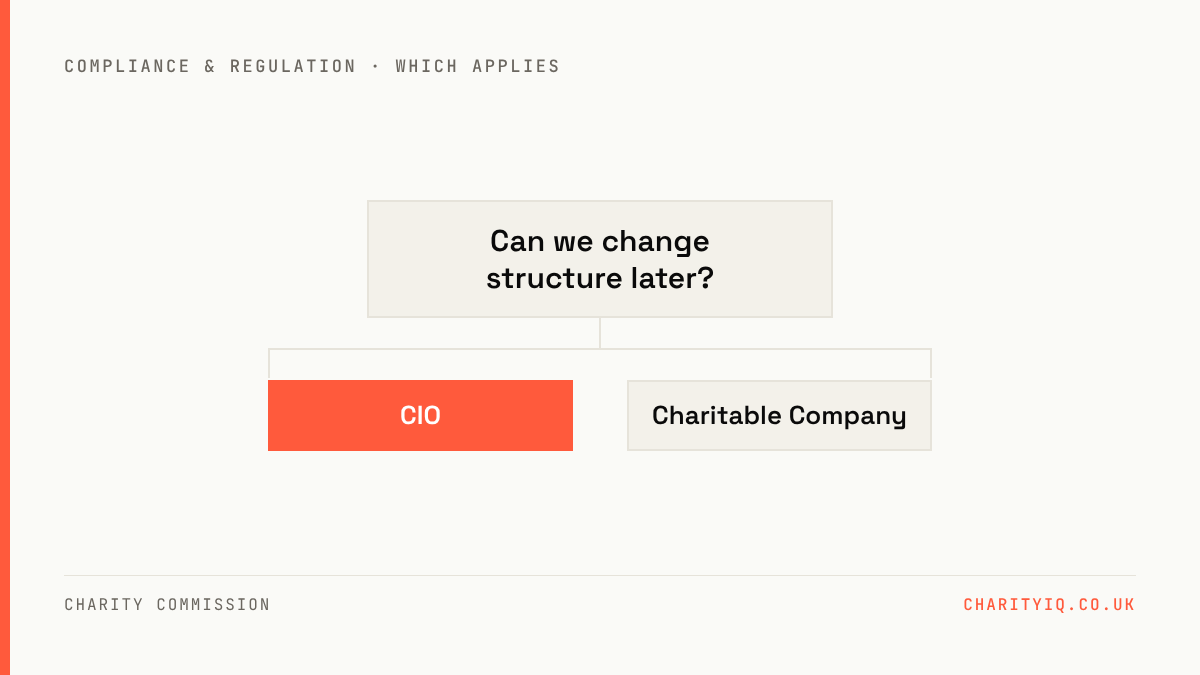
Get it right at the start; changing later is possible but cumbersome.
The two main incorporated charity structures are CIO and charitable company limited by guarantee. (Trusts and unincorporated associations are alternatives but less common for new UK charities — and trustees personally liable in unincorporated associations.)
Side-by-side comparison
| Aspect | CIO | Charitable Company |
|---|---|---|
| Registered with | Charity Commission only | Companies House + Charity Commission |
| Legal personality | Yes | Yes |
| Trustee liability | Limited (charity is separate legal entity) | Limited (members guarantee usually £1) |
| Annual returns | One — to Charity Commission | Two — to Charity Commission AND Companies House |
| Accounts format | SORP-compliant | SORP + Companies Act compliant |
| Speed to register | ~3-4 months | Companies House quick (1-2 days), Commission ~3-4 months |
| Borrowing/charges | Limited (no charges register) | Standard (Companies House charges register) |
| Trading subsidiaries | Awkward | Standard |
| Best for | Small to medium UK charities; first-time founders | Larger or more complex charities; subsidiaries; lending |
| Cost | Free to register | Companies House registration ~£12; otherwise free |
When to choose CIO
The CIO is the right default for most new small UK charities:
✓ Single legal entity (vs need for two registrations)
✓ One annual return (vs two)
✓ Simpler accounts (Companies Act not relevant)
✓ Free to register (no Companies House fees)
✓ Charity-specific structure designed for the sector
Choose CIO if:
– You’re starting fresh
– Annual income is likely under £500k
– You don’t need significant external borrowing
– You don’t have trading subsidiaries
The CIO has been the most common new charity structure since it was introduced in 2013.
When to choose charitable company
The charitable company structure has specific advantages:
✓ Pre-existing limited company brand — easier conversion
✓ Charges register supports lending (e.g., property purchase)
✓ Trading subsidiaries plug in naturally
✓ Companies Act flexibility for member rights, voting, etc.
✓ Some funders (rare) prefer charitable company structure
Choose charitable company if:
– You’re converting an existing limited company to charity
– You expect significant property purchase requiring secured lending
– You plan complex group structures (e.g., charitable company + trading subsidiary)
– You need member voting rights configurable in a specific way
The dual reporting (Charity Commission + Companies House) is the main cost. Many charities don’t realise it’s two annual returns — both required.
Two CIO sub-types — Foundation vs Association
Two CIO models exist:
Foundation CIO — trustees are also the only members. Single layer of governance. Simpler but less democratic.
Association CIO — separate trustees and members. Members elect trustees. More democratic, more like a typical company structure.
Most new CIOs are Foundation type. Association CIOs make sense if you want broader stakeholder governance (e.g., a community organisation where members vote on direction).
Trustees’ personal liability
Both CIOs and charitable companies provide limited liability — meaning trustees aren’t personally liable for the charity’s debts (subject to limited exceptions for serious breach of duty).
This is a significant advantage over unincorporated associations, where trustees can be personally liable. If you’re considering an unincorporated structure for a new charity, think hard about why.
From CharityIQ. CharityIQ supports both CIOs and charitable companies — the compliance dashboard tracks Charity Commission filings and (for charitable companies) flags Companies House deadlines too. See compliance →
Setting up a CIO — the practical steps
The end-to-end process for a new CIO takes 3-5 months. See our setting up a UK charity guide for the full walkthrough.
Key milestones:
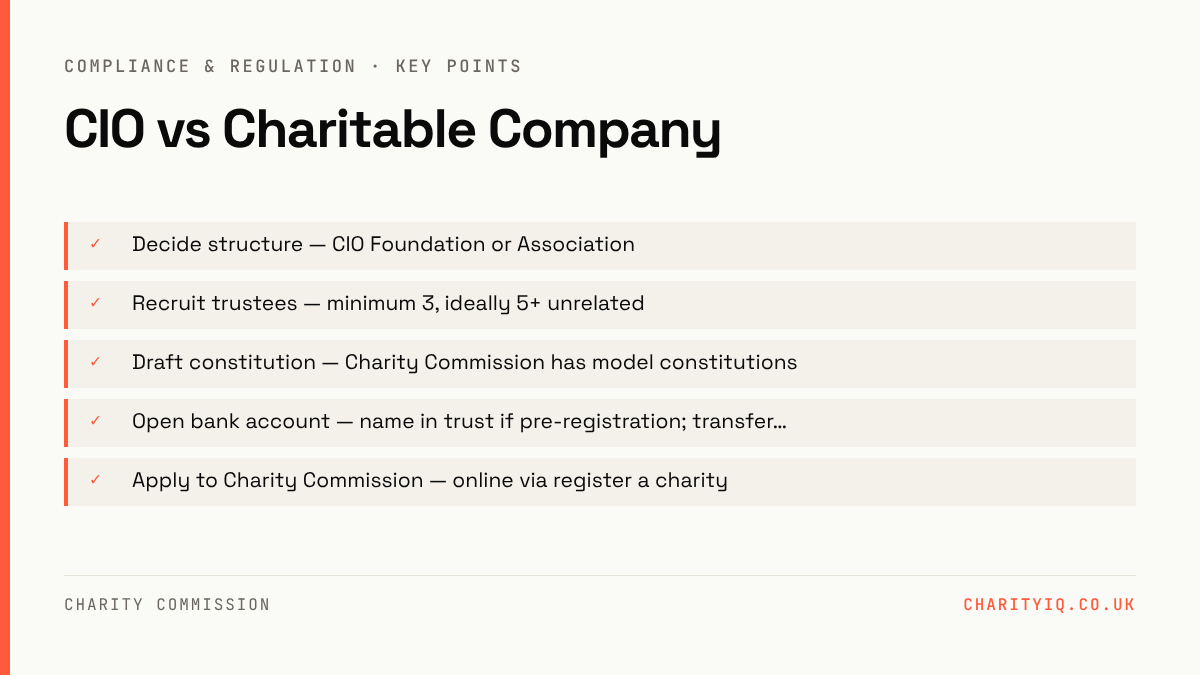
- Decide structure — CIO Foundation or Association
- Recruit trustees — minimum 3, ideally 5+ unrelated
- Draft constitution — Charity Commission has model constitutions
- Open bank account — name in trust if pre-registration; transfer to charity once registered
- Apply to Charity Commission — online via register a charity
- Wait — typically 3-4 months
- Begin trading — with charity registration number on all materials
Common mistakes
1. Picking unincorporated structure for cost reasons. Unincorporated saves nothing meaningful and creates personal liability. Don’t.
2. Charitable company without realising the dual reporting. Two annual returns. Two filing fees. Two penalty regimes if late. Plan for both.
3. Foundation CIO when you want broader governance. If members electing trustees is important, choose Association CIO from the start.
4. Not consulting a charity lawyer for complex setups. Trading subsidiaries, mergers, conversions — get advice. Cost saved by DIY can become costly later.
5. Drafting your own constitution. The Charity Commission’s model constitutions are battle-tested. Use them and amend with care.
What to do this week
If you’re considering setting up a charity:
1. Read Charity Commission’s CC21a guidance on CIOs
2. Review the model constitutions for both CIO and charitable company
3. Speak to a charity lawyer for 1 hour — most offer free initial consultations to charity founders
4. Draft a one-page brief of what your charity will do, why, and who’s involved
Get charity admin right from day one. Start a free 14-day CharityIQ trial. Start free trial →
Frequently asked questions
Yes — you can convert from CIO to charitable company and vice versa, but it’s bureaucratic. Pick the right structure at the start.
For most major UK funders, both CIOs and charitable companies are eligible. Some specifically require registered charity status (which both have). Lloyds Bank Foundation is explicit about CIO acceptance.
A separate structure, regulated by the FCA rather than the Charity Commission. Used by housing associations, community shops, some food projects. Specialist advice needed.
Not a charity. CICs are a hybrid for-profit/social enterprise structure. They have charitable purpose but aren’t tax-exempt as charities. Consider if your work mixes commercial and charitable elements.
CIO: free (Charity Commission charges nothing). Charitable company: ~£12 Companies House fee, plus ~£100-£500 legal fees if you want professional advice on the constitution.