How to Write a Winning UK Grant Application: 2026 Guide
Winning UK grant applications succeed less on the quality of the project than on the clarity with which it is described, so the funder finishes reading confident the money would be well spent. Common reasons applications fail include using national averages instead of local data in the 'Need' section, and confusing outputs (activities done) with outcomes (changes achieved). A 2026 guide organises the advice around the five sections that matter most, assuming a well-matched funder has already been found.
Why most UK grant applications fail (it’s not the project)
The Charity Commission doesn’t track UK grant rejection rates centrally — funders don’t publish them. But sector consensus, drawn from funder feedback published on sites like IVAR’s Open and Trusting initiative, points to a small number of recurring weaknesses.
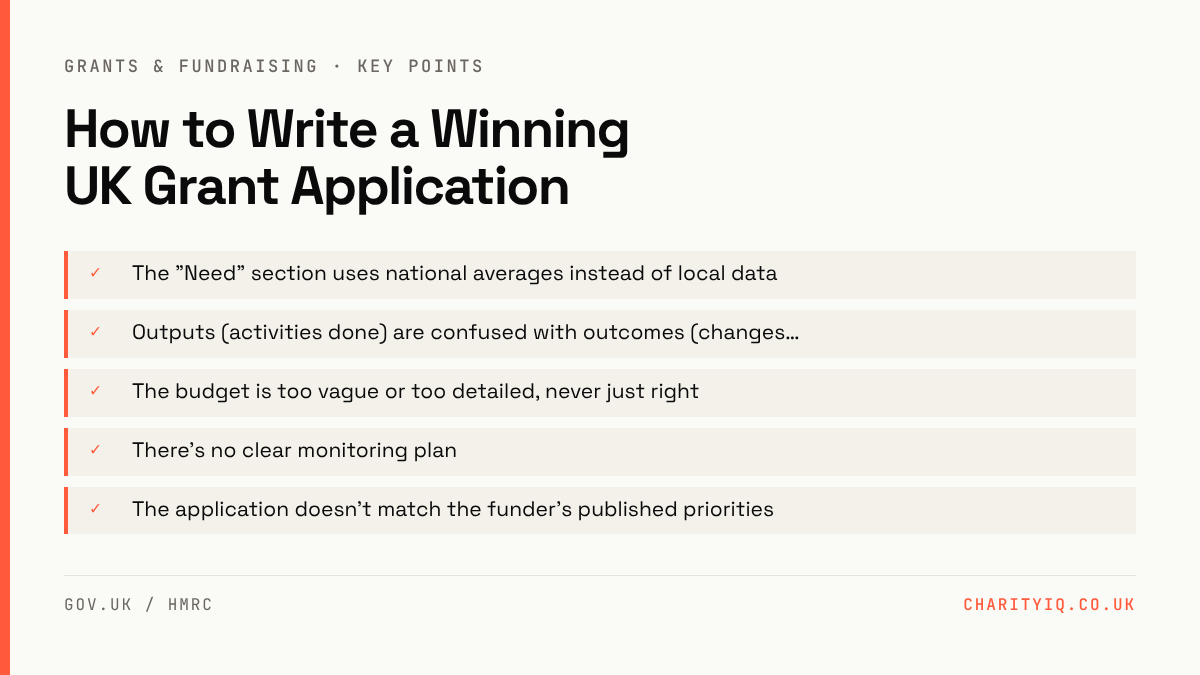
The top five reasons applications fail:
- The “Need” section uses national averages instead of local data
- Outputs (activities done) are confused with outcomes (changes for beneficiaries)
- The budget is too vague or too detailed, never just right
- There’s no clear monitoring plan
- The application doesn’t match the funder’s published priorities
Notice what’s not on the list. “The project isn’t important enough.” Funders rarely reject for that. They reject because they finished the application unsure whether the money would actually deliver what’s promised.
The work, then, is reducing that uncertainty. Section by section.
Before you start — the 5 things to have ready
A common mistake is to start writing before the foundation work is done. Five things should be in your hands before you open the application form:
1. Charity registration details. Your Charity Commission number, year of registration, full charitable objects, current trustees. (If your charity is on the Charity Commission register, all of this is publicly available — but worth having to hand.)
2. Last 12 months of beneficiary data. Numbers reached, demographics, geography. Concrete data, not estimates.
3. A current Theory of Change or programme logic. Even a one-page version. If you can’t articulate the causal chain from inputs → activities → outputs → outcomes, the application will struggle.
4. A realistic budget breakdown. Line items, not lump sums. Salary costs broken out. Direct vs indirect costs identified.
5. The funder’s published criteria. Print it. Read it. Highlight what they explicitly say they fund and explicitly say they don’t.
If any of these is missing, fix it before writing. The application will be 5x faster and 10x stronger with the foundations in place.
The application sections — what funders actually read
Most UK grant applications follow a similar structure. The wording varies but the substance is consistent. We’ll walk through the five sections that nearly every funder asks about.
Need (300 words typical)
The funder is asking: “Why does this work matter, here, now, for these specific people?”
What strong looks like:
– Local data with cited sources — IMD ward rankings, ONS local statistics, borough or council data
– Specific beneficiary group (not “the community”)
– Lived experience evidence — quotes from beneficiaries (with consent), case studies, frontline observations
– A clear connection between national/regional context and the specific local situation
What weak looks like:
– “Mental health is a growing problem in the UK” (true but useless)
– “Many young people in our area struggle” (vague)
– National statistics applied to local context without justification
Practical move: look up your charity’s ward on the English Indices of Multiple Deprivation. If you operate in a high-deprivation ward, lead with that. Specificity convinces.
Activities (250 words typical)
The funder is asking: “What will you actually do with the money?”
What strong looks like:
– Specific activities — what, where, when, for whom
– Frequency and duration (twice weekly, three months, four cohorts of 12)
– Roles of staff and volunteers
– Connection to the Need section (you’re addressing the problem you described)
What weak looks like:
– Generic descriptions (“we will deliver a programme of activities”)
– Activities that don’t follow from the Need section
– Vague timeframes (“over the year”)
Outcomes (300 words typical — and the most important section)
The funder is asking: “What will be different for beneficiaries because of this work?”
This is where most applications lose marks. Outputs vs outcomes confusion is rampant.
Output: “We will deliver 200 youth club sessions.”
Outcome: “Attending young people will report increased confidence and reduced isolation, measured by an end-of-programme survey, with baseline data collected at intake.”
The output is the activity. The outcome is the change.
What strong looks like:
– 3–5 specific, measurable outcomes
– For each outcome: how it will be measured (survey, interview, observation, attendance)
– Time-bound (by end of year 1, 75% of participants will…)
– Realistic numbers (be modest — under-promise, over-deliver)
What weak looks like:
– Outputs labelled as outcomes
– Outcomes without measurement
– Outcomes you can’t realistically attribute to your work
– Wishful thinking (“all participants will improve”)
If you don’t have a Theory of Change, this is the section where the lack shows up most painfully. Worth investing the time to draft one — see Theory of Change Template 2026.
Budget (varies — 1–2 pages typical)
The funder is asking: “Is this the right amount for this work, and will it be spent well?”
What strong looks like:
– Line-itemised costs (staff salaries broken out by role and hours, premises, materials, evaluation, indirect/overheads)
– Connection to the activities — costs follow from what you said you’d do
– Full cost recovery if the funder allows it
– Co-funding clear (where matched, what other sources)
– Realistic — not under-budgeted, not padded
What weak looks like:
– Round numbers without breakdown
– Activities not reflected in the budget (or vice versa)
– Hidden costs
– Salary at “a reasonable rate” without specifying
Practical move: the CFG (Charity Finance Group) has guidance on full cost recovery and overhead allocation. For your first detailed budget, working with a finance volunteer or accountant pays off.
Monitoring & Evaluation (200 words typical)
The funder is asking: “How will you know if it worked?”
What strong looks like:
– Clear data collection methods for each outcome
– Frequency of data collection (baseline, quarterly, end-of-programme)
– Who collects, who analyses, who reports
– Plan for sharing learning with the funder
What weak looks like:
– “We will evaluate the project” (how?)
– Data collection methods not specified
– No baseline data
– No plan for what happens with the findings
A monitoring plan doesn’t need to be complex. For most small charities, a simple combination of attendance records, end-of-programme survey, and 2–3 case studies (with consent) is enough. Funders prefer modest-but-real evaluation over ambitious-but-vague.
Sustainability (150 words typical)
The funder is asking: “What happens when our money runs out?”
What strong looks like:
– Realistic plan — continue with reduced scope, replicate elsewhere, transition to other funder, fundraise to continue
– Honest about uncertainty
– Connected to your charity’s overall fundraising strategy
What weak looks like:
– “We will seek further funding” (everyone says this)
– Promises you can’t keep
– Plans that depend on the same funder funding it again
From CharityIQ
Strong applications quote ward-level data, tie outcomes to funder priorities, and reuse a charity’s saved profile.
CharityIQ pulls postcode-level ONS/IMD data and funder priorities into your draft automatically — what takes a fundraiser 4 hours takes the platform 12 minutes. Draft your next grant in 12 minutes.
A worked example — “Riverdale Youth Trust” £40,000 bid
Below is a brief illustration. The project is fictional; the structure is real.
Funder: National Lottery Awards for All (England)
Amount requested: £18,500 over 12 months
Project: Youth mentoring expansion in a high-deprivation ward
Need (excerpted)
Sample Town Central ward ranks in the most deprived 10% of England (IMD 2019, decile 1). Within the ward, 38% of children live in households below the poverty line (ONS 2024 data, lowest local figure for our authority). Sample Town’s local youth offending rate is 2.4× the regional average (Sample Town Council Annual Report 2025). […]
Our existing mentoring programme has supported 22 young people in the past 12 months. Demand is now exceeding capacity — at the time of writing we have 18 young people on a waiting list, with average wait time of 4 months. Our Council Youth Service partner has confirmed referrals would double in the next year if we had capacity.
Note what makes this strong: cited ward-level data, exact figures, evidence of demand exceeding supply.
Activities
The project will:
– Recruit, DBS-check, and train 14 additional adult mentors (4 cohorts of training across the year)
– Match each mentor with a young person referred from Council Youth Service or local schools
– Provide structured monthly check-ins for the first 6 months of each pairing
– Coordinate quarterly group activities for all mentor-mentee pairs
Specific. Tied to the Need section.
Outcomes
By end of project (month 12):
1. At least 28 mentor-mentee pairs active (baseline: 22 active pairs at start)
2. 75% of young people in 6+ month relationships report increased confidence (measured by validated Rosenberg Self-Esteem Scale, baseline at intake)
3. At least 12 young people supported into apprenticeship, training, or further education during the programme year (data from end-of-pairing review)
4. At least 80% of mentors complete the full year (baseline: 73% retention in current cohort)
Specific, measurable, with measurement methods named.
Budget
Item Cost Mentor coordinator (0.4 FTE @ £28k pro rata + on-costs) £13,200 DBS checks (14 mentors @ £24) £336 Training delivery (4 cohorts, materials and venue) £1,800 Quarterly group activity costs £1,400 Evaluation (external review at end of year) £1,200 Indirect/overhead allocation (10%) £564 Total £18,500
Line items, not lumps. Allows the funder to see exactly what they’re paying for.
Monitoring & Evaluation
Mentor coordinator collects monthly attendance and milestone data. Self-esteem scale completed by young people at intake and at month 6. End-of-programme review interviews with all young people who reach 12 months. End-of-year report shared with funder, including learning. External evaluator reviews methodology and reports findings.
Sustainability
The mentor model is volunteer-led, keeping ongoing costs low. The 0.4 FTE coordinator role would be sustained beyond the funded year through Council Youth Service contracts (in negotiation) and matched fundraising from local businesses (committed pipeline £8,000 for 2027-28).
30 phrases that strengthen a draft (and 15 to delete on sight)
A short selection. Full list in our 30 phrases post (coming soon).
Strong:
– “We will achieve [specific outcome] by [specific method]”
– “Baseline data collected at intake”
– “[Specific source, year]”
– “78% of participants reported… (n = 64)”
– “Year on year, attendance grew from…”
Weak — delete:
– “We are passionate about…”
– “We will leverage…”
– “Our innovative approach…”
– “Robust monitoring framework”
– “We hope to…”
The verbs that work in grant writing are concrete: deliver, recruit, train, match, support, evaluate, report. The verbs that don’t: empower, leverage, transform, harness, drive.
How long it should take — and where AI saves time
Charity Digital’s research suggests UK fundraisers spend 15–40 hours on a typical grant application, depending on funder requirements and the writer’s experience (Charity Digital Skills Report 2025).
That time breaks down roughly:
– Funder research and eligibility check: 2–4 hours
– Reading the application form and guidance: 1 hour
– Gathering charity data and evidence: 3–6 hours
– Drafting Need section: 3–5 hours
– Drafting Activities, Outcomes, M&E: 4–8 hours
– Drafting Budget: 2–4 hours
– Internal review and editing: 2–4 hours
– Submitting: 1 hour
Where AI saves time well:
– Drafting first versions of Need, Activities, Outcomes (saves 4–6 hours)
– Reformatting content for different funders (saves 2 hours per repeat application)
– Plain-language editing (saves 1–2 hours)
Where AI doesn’t save time (and shouldn’t):
– Funder research (you need to actually read the funder’s site)
– Budget drafting (specifics require human judgement)
– Beneficiary data — must be accurate and current
– Final review — a human must catch hallucinations and tone issues
Generic AI like ChatGPT can help with drafting but requires careful re-checking. Sector-specific tools that pull from your charity’s verified data avoid most of the hallucination risk — see our comparison post.
After you submit — what to do
- Log it. Spreadsheet or grant tracker. Funder, amount requested, date submitted, expected decision date.
- Send a personal thank-you. Email the funder contact (not the generic inbox) noting your submission and thanking them for the opportunity to apply. One short paragraph. Not all funders reply, but it builds relationship for next time.
- Plan the next application. Don’t wait for the decision. Find your next two funders and start the same process.
- If rejected, ask for feedback. Polite email. Most funders provide some — even a single sentence. Use it.
What to do next
Two practical actions for any UK charity reading this:
1. Pick your next funder. Use our grants for small UK charities guide to identify a realistic match. Don’t write speculatively — write to a specific funder with specific criteria.
2. Build your reusable foundation. Theory of Change, beneficiary data, line-item budget template, outcomes framework. Once these exist, every future application gets faster.
For charities applying to multiple grants per year, that’s exactly what we built CharityIQ for. The platform stores your charity profile once and tailors each application to the funder’s specific criteria. Drafts in 12 minutes from your saved data, with citations on every fact.
Ready to draft your next grant in 12 minutes?
Start a free 14-day CharityIQ trial. No credit card. Your data, your draft.
Start free trial →
Frequently asked questions
First-time applications typically 15–40 hours, including funder research and internal review. Subsequent applications get faster — once you have a charity profile, theory of change, and outcomes framework, the per-application time drops to 8–12 hours.
Outcomes. Funders consistently report this is where applications win or lose. A clear, measurable, attributable outcome statement transforms an application’s credibility.
Use ward-level data. Cite sources. Combine national context with specific local evidence. Quote beneficiaries (with consent). Avoid generic statements — every sentence should add something the funder doesn’t already know.
For first drafts, yes — generic AI can save hours. For final submission, the application must be rigorously fact-checked. Hallucinated statistics in grant applications damage trust if discovered later. Sector-specific AI tools that ground every claim in your charity’s verified data are safer than ChatGPT for this purpose.
Varies widely by funder. National Lottery Awards for All success rate is roughly 40–50% across all applications. Trust and foundation grants for small charities typically 20–30%. Larger charities achieve higher rates partly through better fundraising teams. Plan to submit 3–4 applications for every grant you win.