Charity Audit Thresholds & Independent Examination 2026
UK charities need neither an audit nor an independent examination when gross income is under £25,000; between £25,000 and £1 million, an independent examination is normally sufficient. A statutory audit becomes compulsory once gross income exceeds £1 million, or income exceeds £250,000 with gross assets over £3.26 million. Charitable companies also have a separate, lower company-law audit threshold, and who can act as examiner depends on the income band.
The thresholds at a glance
I file the annual return for my own small charity, so charity audit thresholds aren’t theory for me — I check our figures against them every year before the Charity Commission asks. Most charities registered in England and Wales fall into one of three tiers under the Charity Commission’s CC15d guidance: no external scrutiny under £25,000 income, independent examination from £25,000 up to £1 million, and statutory audit above £1 million income (or above £250,000 income with gross assets over £3.26 million). The detail sits in CC15d itself; the wider year-end picture sits in our charity compliance handbook. This guide deals with the scrutiny question alone.
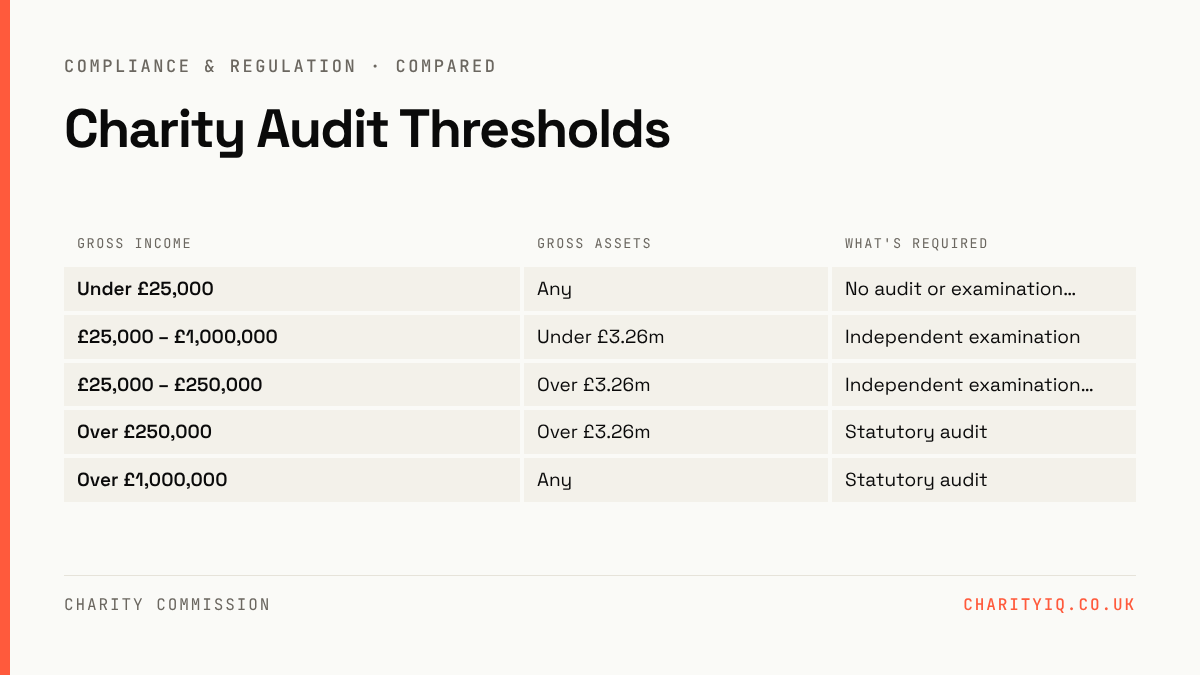
| Gross income | Gross assets | What’s required |
|---|---|---|
| Under £25,000 | Any | No audit or examination — trustees approve the accounts |
| £25,000 – £1,000,000 | Under £3.26m | Independent examination |
| £25,000 – £250,000 | Over £3.26m | Independent examination (by a person with relevant professional qualifications, per the Charities Act 2011 s.145) |
| Over £250,000 | Over £3.26m | Statutory audit |
| Over £1,000,000 | Any | Statutory audit |
The audit threshold checker will apply these bands to your own figures.
Trustees can also choose a full audit voluntarily even when only an examination is required, for example where a funder’s terms or the governing document demands one. Always check your governing document first: some older trust deeds specify a lower audit threshold than charity law does, and that overrides the statutory minimum.
These thresholds are rising, though. The figures above are correct for financial years ending before 30 September 2026; for year-ends on or after that date, the independent-examination trigger rises from £25,000 to £40,000 income, the audit threshold from £1 million to £1.5 million, the combined test from £250,000 income plus £3.26 million assets to £500,000 plus £5 million, and the professionally-qualified-examiner band from £250,000 to £500,000 (SI 2026/427). The receipts-and-payments accounts ceiling moves from £250,000 to £500,000 too, and the group-accounts threshold from £1 million to £1.5 million aggregate. If your year-end lands on or after 30 September 2026, check which regime applies before you book anything.
Audit vs independent examination — the difference
A statutory audit is a full, in-depth check of the accounts by a registered auditor giving an opinion on whether they give a “true and fair view”; an independent examination is a lighter-touch review by a suitably qualified independent person confirming nothing has come to their attention suggesting the accounts don’t add up. Audits cost more and take longer, but give stronger assurance to large funders and lenders.
An examiner’s report answers a narrower question than an auditor’s: broadly, whether accounting records were kept properly and whether the accounts are consistent with them. It is not an opinion on whether the accounts are “true and fair” — that level of assurance is reserved for a full audit. Many trusts and grant-makers accept an independent examiner’s report for grants under a certain size, but check individual funder terms; some large statutory funders insist on audited accounts regardless of your charity-law threshold.
Who can examine your accounts
Below £250,000 income, an independent examiner needs no formal accountancy qualification, only to be someone independent of the charity’s management with the ability and practical experience to carry out a competent examination — trustees must be satisfied they’re the right person for the job. Above £250,000 income, the examiner must hold one of the recognised professional qualifications listed in the Charities Act 2011.
- Under £250,000 income: any competent, independent person the trustees are satisfied is capable, per CC15d. This can be an experienced treasurer from another charity, a retired finance professional, or a qualified accountant who isn’t already involved in running your charity.
- Over £250,000 income: a member of a recognised body — ICAEW, ACCA, ICAS, CIPFA, ACA, or equivalent — as required by the Charities Act 2011, section 145.
- Independence test: the examiner cannot be a trustee, an employee, a major donor with influence over decisions, or a close relative of anyone in those roles.
If your charity is also a company, Companies House rules on who can audit still apply separately from Charity Commission rules, so a company-charity above the company audit threshold needs a registered company auditor, not just an independent examiner, even if the charity-law threshold alone would have permitted an examination.
What the examiner checks
An independent examiner checks that accounting records were kept in line with the Charities Act, that the accounts agree with those records, and that any unusual items or departures from applicable accounting standards are followed up and explained. They do not audit every transaction and do not offer an opinion on whether the accounts present a true and fair view.
In practice, the examiner will typically ask to see bank reconciliations, minutes covering major financial decisions, the fixed asset register, restricted fund records, and evidence supporting the biggest income and expenditure lines. Weak record-keeping is the single most common reason examinations take longer and cost more than trustees expect. The habit that pays for itself at my own charity is coding restricted funds as the money arrives, not in a reconciliation scramble at year-end.
From experience: Independent examiners chase records, not perfection. What drags an examination out is missing paperwork — an unreconciled bank account, restricted funds never coded, a large grant with no minute behind it. Trustees tend to worry about what the examiner will conclude; I’d put that energy into the paper trail, because clean records make the conclusion take care of itself.
The SORP 2026 wrinkle: tiers vs thresholds
The new Charities SORP, effective for reporting periods starting on or after 1 January 2026, introduces reporting tiers — Tier 1 for gross income up to £500,000, Tier 2 from £500,000 to £15 million, Tier 3 above £15 million — that determine how much disclosure your accounts need. But these tiers are separate from, and don’t replace, the audit and independent examination income/asset thresholds set out above. Read the full SORP 2026 trustee guide for what changes in your Trustees’ Annual Report and accounts format.
Don’t confuse the two: SORP tier decides how detailed your accounts disclosures must be. The audit/examination threshold decides who has to check them. A charity can sit in a lower SORP tier and still need a full statutory audit if its income or assets cross the Charity Commission thresholds.
Use CharityIQ’s tier checker to see which SORP tier and which audit/examination threshold applies to your charity in one pass, or the standalone SORP tier checker for the reporting-tier answer alone — I built both because juggling two sets of bands for my own filings kept catching me out.
Costs and how to keep them down
Independent examination fees for a small charity typically run from a few hundred pounds for the simplest accounts to a few thousand for more complex, multi-fund charities; a full statutory audit generally costs several times more than an examination for a similarly sized charity, because of the extra testing required.
The cost-savers are boring housekeeping — the same routine I work through at my own charity, scrutiny or no scrutiny:
- Keep restricted and unrestricted funds separately coded all year, not reconciled retrospectively at year-end — our financial year-end close checklist keeps this honest.
- Reconcile the bank account monthly so the examiner isn’t the first person to spot a gap.
- Minute significant financial decisions as they happen — grants awarded, loans taken, assets disposed of.
- Get quotes from 2–3 examiners in the months before year-end, not after; demand spikes around common year-end dates (31 March, 31 December) push prices up.
- Complete your annual return promptly once the examination is done — the annual return prep checklist covers what to gather; CharityIQ’s annual return walkthrough covers the filing steps.
What to do next
Work out your charity’s gross income and gross assets for the year, check both figures against the thresholds table above, and confirm what your governing document says separately, since it can set a stricter requirement than the law does. If you’re within reach of a threshold, plan ahead rather than discovering the requirement at filing time — and remember the bands rise for year-ends on or after 30 September 2026.
- Run your income and assets through CharityIQ’s tier checker to confirm your exact requirement.
- If you need an examiner, get quotes early and check their independence and (if relevant) qualification.
- Tidy your fund coding and bank reconciliations now, not at year-end.
- Read the SORP 2026 trustee guide so your accounts format is ready for the new reporting year.
Want the compliance module to flag your threshold automatically as your accounts update? Join the compliance module waitlist →
Frequently asked questions
Only if gross income exceeds £1 million in the year, or income exceeds £250,000 and gross assets exceed £3.26 million. Below those levels, an independent examination is normally sufficient unless your governing document or a funder specifically requires a full audit regardless of size.
£1 million gross income triggers a statutory audit on its own. Below that, a lower combined trigger applies: income over £250,000 plus gross assets over £3.26 million also requires an audit, even though income alone wouldn't. Check both figures, not just income.
Under £250,000 income, any independent person the trustees consider competent can examine the accounts. Above £250,000 income, the examiner must belong to a recognised professional body such as ICAEW, ACCA, ICAS or CIPFA, as set out in the Charities Act 2011.
No. Independent examiners must be independent of the charity's management and decision-making, so a serving trustee, employee or close relative of either cannot examine their own charity's accounts, regardless of how well qualified they are.
Filing accounts without a required audit or examination is a breach of charity law and the annual return will be flagged incomplete or rejected. Persistent non-compliance can lead to Charity Commission regulatory action, including a statutory inquiry in serious cases.
Generally yes, because it involves less testing and lower professional-indemnity risk for the examiner than a full statutory audit. Exact savings vary by charity complexity, so get comparable quotes for both if you're near a threshold and deciding whether to opt up voluntarily.