The Waterloo Foundation: How to Apply (2026 Guide)
The Waterloo Foundation funds UK and international work through several distinct programmes, including child development, environment, Wales-specific funding and world development, each with its own grant size, deadline and application process. Some funds run rolling or invitation-only rounds, so current status should be checked directly with the Foundation. Charities that do not fit its programmes may find Garfield Weston or The Fore a closer match.
Who they fund (and exclusions)
If a Waterloo Foundation application is on your plate this quarter, you don’t need the foundation’s history — you need to know which fund fits, what it pays, and when it closes. Here’s the working version, from someone who read hundreds of funder pages while building CharityIQ’s grant-finder. The Waterloo Foundation is a grant-making trust that funds work across several distinct areas — historically early child development, environment and sustainability, Wales-focused community work, and international development — each run as a broadly separate programme with its own criteria. Because the foundation operates multiple funds rather than one generic pot, the first step for any applicant is identifying which specific fund matches their work, not applying to “Waterloo Foundation” generically. (If trust fundraising is new to you, start with our grant funding handbook.)
Typical charity funders in this category exclude individuals, general appeals with no specific project focus, and organisations outside their stated geographic or thematic remit. Check the current list of funds, eligibility criteria and exclusions directly on the Waterloo Foundation’s own website before drafting an application, as programme scope and exclusions can change between funding rounds.
Grant size and what it covers
Grant sizes at foundations of this type typically range from a few thousand pounds for small, community-level projects up to significantly larger multi-year awards for strategic programme funding, but the exact bands differ by fund and change over time. Check the current grant size bands and which costs are eligible (project costs, core costs, capital) for each specific Waterloo Foundation programme before budgeting your application.
Do not assume core costs are covered by default. Many trusts fund project costs only unless they explicitly state core-cost or unrestricted funding is available, so check this distinction on the live guidance for the specific fund you’re applying to — of everything I learned reading funder pages for the grant-finder, project-versus-core is the distinction that catches small charities most often.
Deadlines and decision timeline
Some funds operate on a rolling basis with no fixed deadline, while others run to specific application windows or are invitation-only following an expression of interest; this varies by which Waterloo Foundation programme you’re applying to. Confirm the current deadline structure and typical decision timeline for your target fund directly with the foundation, as these details are the most likely to change between rounds and are not safe to assume from historical data.
Build in time for a two-stage process if the fund uses one: many trusts of this size ask for a short expression of interest before inviting a full application, which can add several weeks to the overall timeline even before a decision is made.
How to apply, step by step
A Waterloo Foundation application rewards method over speed: confirm the right fund, read the current guidance in full, prepare your supporting evidence in advance, and submit exactly what’s asked for, no more and no less.
- Identify the right fund from the foundation’s current published list, matching your cause area, geography and organisation size.
- Read the live eligibility criteria in full on the funder’s own site, since these are the fastest-changing part of any funder’s offer.
- Prepare your evidence base: your theory of change, most recent accounts, and any outcome data relevant to the fund’s priorities.
- Draft to the fund’s actual questions, not a generic template, and keep language plain and specific rather than aspirational — our annotated grant application answers show what that reads like.
- Submit via the stated channel (online portal, email, or post), run the pre-submit checklist first, and note any confirmation reference for follow-up.
What winning applications look like (use 360Giving/GrantNav data)
Rather than guessing what a funder likes, check the 360Giving GrantNav open data platform, which publishes details of grants actually awarded by many UK trusts and foundations, including amounts, recipients and purposes where funders have published their data. This lets you see real, funded examples of the kind of project size, cause area and organisation type a funder has supported historically, rather than relying only on marketing copy.
Search GrantNav for the funder’s past awards to get a realistic sense of typical grant size and the kinds of organisations funded, then cross-check this against the funder’s current live guidance, since programmes evolve and a fund’s past pattern is not a guarantee of future eligibility. I lean on GrantNav constantly — for CharityIQ’s funder research and when shortlisting funders for my own charity.
From experience: Grant applications mostly fail before the writing starts — on eligibility, not quality. Reading hundreds of funder pages while building CharityIQ’s grant-finder taught me a pre-flight habit I now use for my own charity’s applications: check the live criteria, check the deadline structure, then check what the funder actually paid for on GrantNav. If those three don’t line up with your project, good prose won’t rescue the bid.
Not eligible? Similar funders
If your charity doesn’t fit the Waterloo Foundation’s current criteria, geography or cause area, consider other UK trusts with comparable scale and focus rather than treating one rejection as the end of the road. When I shortlist funders for my own charity, fit comes before fame: a smaller fund whose criteria you clearly meet beats a famous one where you’re a marginal case.
- Garfield Weston Foundation: one of the UK’s largest general grant-makers, funding a broad range of causes and organisation sizes.
- The Fore: focused on smaller, often overlooked charities and social enterprises, with a more accessible application process for first-time applicants.
- Grants for small charities (pillar guide): a broader roundup if you need alternatives beyond these two.
Use CharityIQ’s Grant Finder to check your eligibility against Waterloo Foundation and similar funders in one search, rather than working through each funder’s website manually — and run the grant readiness checker first if you’re not sure your evidence base is bid-ready.
What to do next
Confirm which specific Waterloo Foundation fund matches your cause area and geography, read that fund’s current live guidance in full, and prepare your evidence base before drafting. Don’t rely on secondhand summaries, including this one, for grant size, deadlines or eligibility on the day you apply.
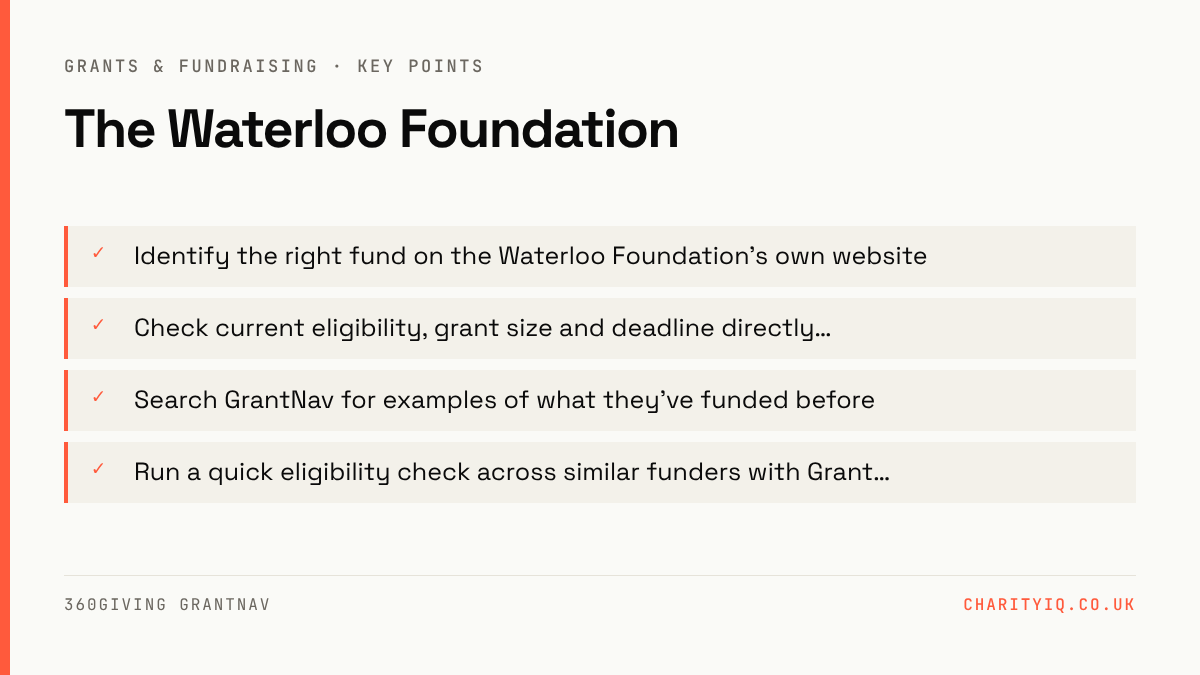
- Identify the right fund on the Waterloo Foundation’s own website.
- Check current eligibility, grant size and deadline directly with the funder.
- Search GrantNav for examples of what they’ve funded before.
- Run a quick eligibility check across similar funders with Grant Finder.
Want to check your eligibility against Waterloo Foundation and hundreds of similar funders in one search? Run a free Grant Finder eligibility check →
Frequently asked questions
Historically, distinct programmes covering areas such as early child development, environment and sustainability, Wales-focused work, and international development, each with its own criteria. Verify the current live list of funds on the funder's site before applying, as programme scope can change.
Grant sizes vary significantly by fund, from smaller community-level awards to larger multi-year programme grants. Verify current grant size bands for the specific fund you're targeting on the funder's site, rather than relying on a single average figure.
Some Waterloo Foundation programmes are Wales-specific while others operate more broadly across the UK or internationally, depending on the fund. Verify geographic eligibility for the specific fund that matches your cause area on the funder's site.
Timelines vary by fund and whether it uses a rolling process, fixed rounds, or a two-stage expression-of-interest system. Verify the current decision timeline in that fund's live guidance before planning your project start date around it.
Most trusts allow reapplication after a stated minimum period, often around 12 months, though this varies by funder and fund. Verify the Waterloo Foundation's current reapplication policy on their site, and use any feedback given to strengthen a future bid.
Yes. Rather than reading every fund's criteria manually, run your charity's details through CharityIQ's Grant Finder, which checks your eligibility against multiple funders including Waterloo Foundation in a single search.