SORP 2026 vs SORP 2019: Every Change Explained
SORP 2026 replaces SORP 2019 for charity accounting periods starting on or after 1 January 2026. Its biggest change is structural: a new three-tier reporting framework — Tier 1 under £500,000, Tier 2 £500,000 to £15m, and Tier 3 over £15m — replaces the previous one-size regime. Separately, the Charities Act threshold for SORP-compliant accruals accounts in England and Wales doubles from £250,000 to £500,000 for financial years ending on or after 30 September 2026 (SI 2026/427). A new five-step income recognition model applies to exchange transactions, and future plans and volunteer contribution move from good practice to required for every tier; the explicit impact narrative is required from Tier 2, and whether a Tier 1 charity must include one is contested — a short narrative is the safe course.
The short answer
SORP 2026 keeps the same foundations as SORP 2019 — it’s still built on FRS 102, still issued by the UK charity regulators, still requires a trustees’ annual report and accounts. What changed is the shape: reporting is now proportionate to income through three tiers, several previously-optional narrative sections became mandatory, and income recognition for contracts follows a new five-step model. SORP 2026 applies to accounting periods starting on or after 1 January 2026; SORP 2019 still governs everything before that date.
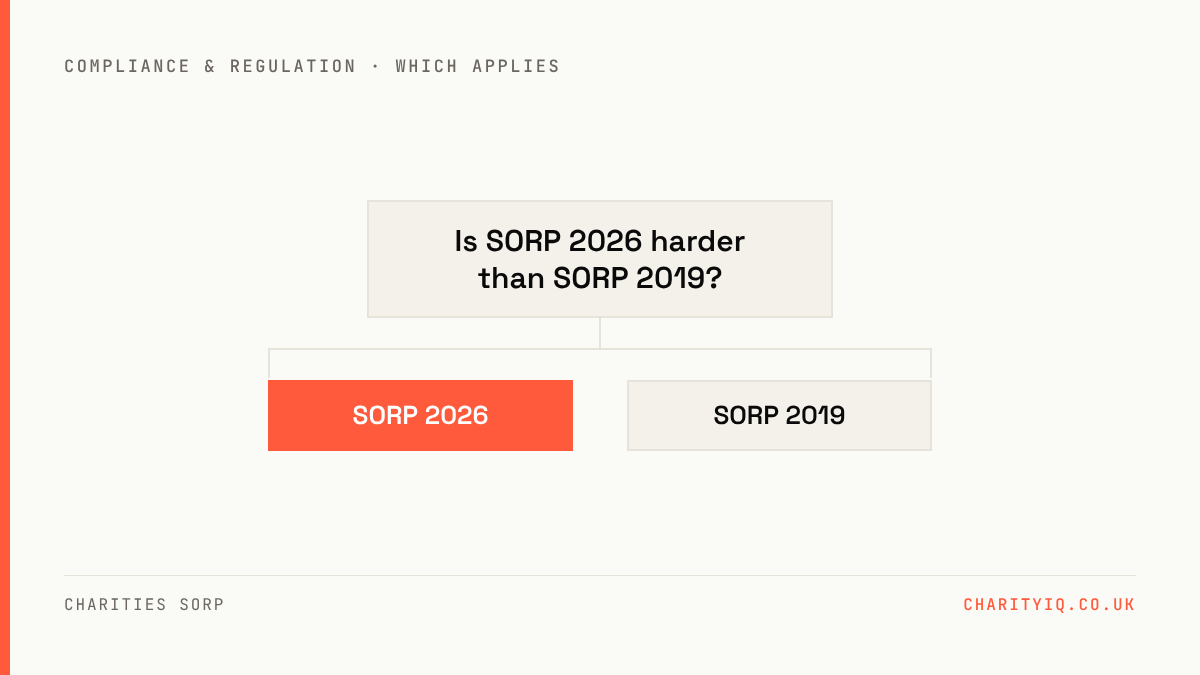
SORP 2019 vs SORP 2026 — the master comparison
| Area | SORP 2019 (FRS 102) | SORP 2026 | What it means for you |
|---|---|---|---|
| Reporting structure | Single framework, scaled mainly by audit thresholds | Three tiers by gross income: Tier 1 < £500k, Tier 2 £500k–£15m, Tier 3 > £15m | Most charities are Tier 1 — explicitly lighter reporting |
| Accruals-accounts threshold (Charities Act, England & Wales) | £250,000 | £500,000 for financial years ending on or after 30 September 2026 (SI 2026/427 — a statutory change alongside the SORP, not part of it) | More small charities can use simpler receipts-and-payments accounts |
| Income recognition | Recognised on entitlement, probability, measurement | Five-step model for exchange transactions (FRS 102 Section 23) | Mainly affects contracts/fees; most grants and donations are largely unchanged |
| Impact in the annual report | Good practice, not required | Explicit impact narrative required from Tier 2; Tier 1 must summarise main achievements — whether the narrative itself is required at Tier 1 is contested | Describe the difference made, not just activities — at every tier, that is the safe course |
| Future plans | Encouraged | Mandatory at all tiers | A written, board-approved forward look is now expected |
| Volunteer contribution | Optional narrative | Required disclosure | Report volunteer roles/hours/value where reasonably calculable |
| Reserves | Stated in narrative | Narrative figure must reconcile to the accounts | Your stated reserves must match the balance sheet, with differences explained |
| Cash flow statement | Required for larger charities | Mandatory only at Tier 3 (over £15m) | An easement — fewer mid-sized charities need one |
| ESG / sustainability | Not a SORP requirement | Mandatory for Tier 3 only | Small and mid charities can ignore; £15m+ charities must act |
| Effective date | Periods from 1 Jan 2019 | Periods starting on/after 1 Jan 2026 | SORP 2019 still applies to earlier periods |
Change 1 — A proportionate, three-tier framework
The headline change. SORP 2019 applied broadly the same disclosure expectations to a £60,000 community group and a £4m charity, with relief mostly tied to audit thresholds. SORP 2026 replaces that with three tiers set by gross annual income:
- Tier 1 — under £500,000: the great majority of UK charities. Simplified disclosures, income and expenditure by natural classification, no mandatory cash flow statement.
- Tier 2 — £500,000 to £15m: expanded analysis by activity and more detailed reserves disclosure.
- Tier 3 — over £15m: full regime, including a mandatory cash flow statement and ESG/sustainability narrative.
Not sure which applies to you? Use the SORP 2026 tier checker — enter your income and it returns your tier and the obligations that come with it.
Change 2 — The accruals threshold doubles to £500,000 (alongside the SORP, not in it)
Charities in England and Wales have been drawn into SORP-compliant accruals accounts at £250,000 income. That threshold doubles to £500,000 — but it is set by the Charities Act 2011 as amended by SI 2026/427, not by the SORP, and it bites on financial years ending on or after 30 September 2026 (a period-ending basis, unlike the SORP tiers, which turn on periods beginning on or after 1 January 2026). In practice, more small charities can now use simpler receipts-and-payments accounting (where eligible and not required to audit), reducing the compliance load for the smallest organisations. If you sit just under £500k, talk to your accountant about whether simpler accounts are now an option for you.
Change 3 — A five-step income recognition model
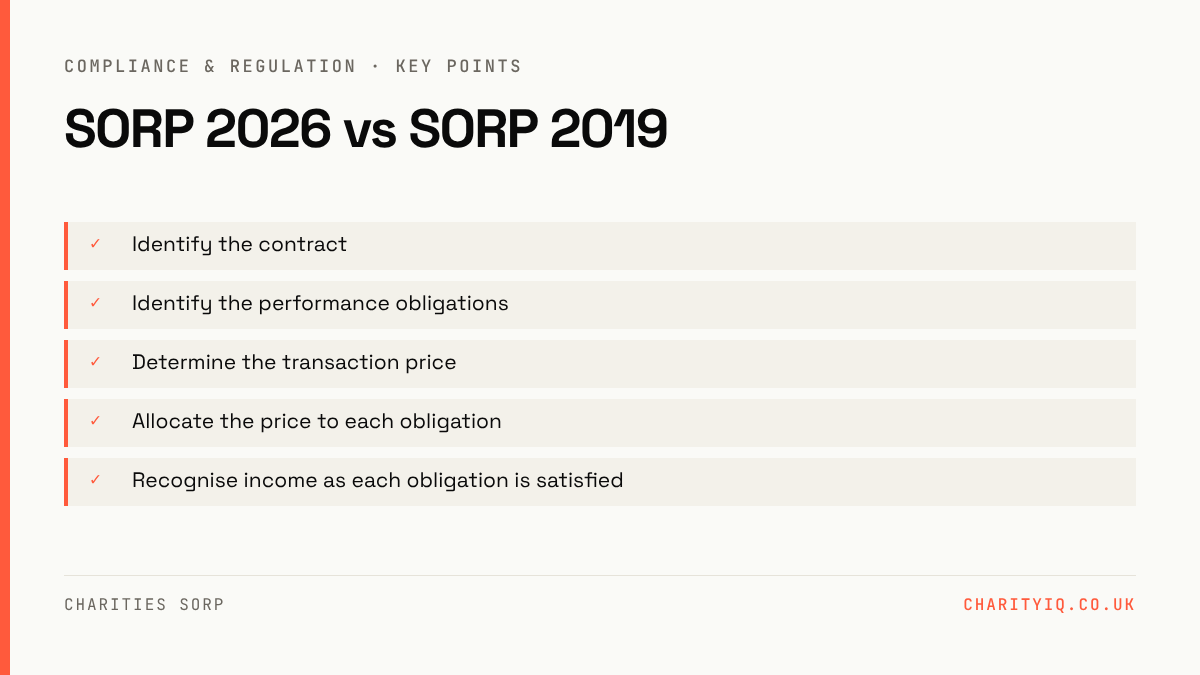
This is the most technical change and the one most likely to need professional advice. SORP 2026 introduces a five-step model for exchange transactions — where your charity provides goods or services of roughly equal value in return for income (a paid course, a delivery contract with a council, ticket sales).
- Identify the contract.
- Identify the performance obligations.
- Determine the transaction price.
- Allocate the price to each obligation.
- Recognise income as each obligation is satisfied.
Non-exchange income — donations, fundraising, and most foundation grants — is largely unaffected. So a charity funded mainly by grants and donations will feel this minimally; a charity delivering paid contracts to a local authority should ask its accountant how the timing of its income changes.
Change 4 — The trustees’ annual report does more
SORP 2019 treated impact and forward-looking narrative as good practice. SORP 2026 makes several of these required:
| Trustees’ annual report element | SORP 2019 | SORP 2026 |
|---|---|---|
| Impact / difference made | Good practice | Explicit narrative required from Tier 2; contested at Tier 1 (see below) |
| Plans for the future | Encouraged | Mandatory (all tiers) |
| Volunteer contribution | Optional | Required disclosure |
| Reserves reconciliation | Narrative figure | Must reconcile to the accounts |
| ESG / sustainability | Not required | Mandatory (Tier 3 only) |
Under SORP 2026, a Tier 1 charity’s binding duty (para 1.27) is a summary of main achievements — addressing how the charity’s work changed beneficiaries’ circumstances. The explicit impact narrative in para 1.30, explaining impact and considering the long-term effect on beneficiaries and society, is formally a Tier 2 requirement, triggered above £500,000 income. Confusingly, the SORP-making body’s own Summary of Changes describes impact reporting as now a “must” for all charities, without that tier distinction. The safest reading: a Tier 1 charity that includes a short impact narrative is on solid ground, and one that omits it entirely may be asked why, even though Module 1’s letter does not strictly require it below Tier 2.
For a Tier 1 charity the practical shift is the same either way: articulate what changed for the people you serve, not just what you did. If you don’t yet collect outcome data, SORP 2026 is the prompt to start. (We cover this in depth in the SORP 2026 impact narrative guide.)
From CharityIQ
The mechanics didn’t get harder — the narrative did. The new report wants impact, future plans, volunteer value and a reconciled reserves position, in plain English.
CharityIQ drafts a tier-aware Trustees’ Annual Report from your live charity data, flags the sections SORP 2026 now requires, and cites every figure. Trustees review and approve. See how it works.
What did not change
To keep this in proportion, several things carry over from SORP 2019:
- It’s still based on FRS 102 and issued by the Charity Commission (England & Wales), OSCR, and CCNI.
- You still file your trustees’ annual report and accounts within 10 months of your financial year-end.
- The fund accounting model (restricted, unrestricted, endowment) is unchanged.
- Most donation and grant income recognition principles continue as before.
When does the switch happen for your charity?
SORP 2026 applies to accounting periods that start on or after 1 January 2026 — so the first set of accounts affected depends on your year-end:
- 31 December year-end: first SORP 2026 accounts = year ending 31 December 2026 (file by 31 October 2027).
- 31 March year-end: SORP 2019 still applies to year ending 31 March 2026; SORP 2026 first applies to year ending 31 March 2027 (file by 31 January 2028).
- 30 June year-end: SORP 2026 first applies to year ending 30 June 2027 (file by 30 April 2028).
What to do next
- Confirm your tier and your first SORP 2026 year using the tier checker.
- Start your impact narrative now — required from Tier 2, the safe course at Tier 1, and the hardest part of the report to write at the last minute.
- Flag any contract income to your accountant for the five-step model.
For charities that want the new trustees’ annual report drafted from their own data — impact, reserves, future plans, all cited — that’s exactly what we built CharityIQ for.
Ready for SORP 2026 without the spreadsheet panic? Tier-aware drafts. Audit trail by default. Start free trial →
Frequently asked questions
For most small charities, no — it's designed to be lighter. The three-tier framework reduces disclosure for Tier 1 (under £500k), and the accruals-accounts threshold doubles to £500,000 for financial years ending on or after 30 September 2026 (SI 2026/427). The added work is narrative: future plans and volunteer contribution are now required at every tier, and an impact narrative is required from Tier 2 (contested at Tier 1 — include a short one).
For accounting periods starting on or after 1 January 2026. Earlier periods still report under SORP 2019. If your year-end is 31 March 2026, you report that year under SORP 2019.
The move to a three-tier, income-based reporting framework, alongside making future plans mandatory in the trustees' annual report and the explicit impact narrative a Tier 2 requirement.
Most foundation grants are non-exchange income and are largely unaffected. The new five-step model applies primarily to exchange transactions — contracts, fees and sales. Ask your accountant about any service-delivery contract.
Only Tier 3 charities (over £15m) face a mandatory cash flow statement under SORP 2026 — an easement compared with the previous regime. FRS 102 may still apply in specific cases; confirm with your accountant.