SORP 2026: A Trustee’s Plain-English Guide
SORP 2026 is the biggest single accounting change UK charity trustees face this year. SORP stands for Statement of Recommended Practice, the document that sets out how charities prepare their accounts and Trustees' Annual Report. A new proportionate framework is designed to reduce the reporting burden on the smallest charities, with requirements varying by tier. Trustees should identify which tier applies to their charity and prepare for new narrative reporting on impact, volunteers, reserves and future plans.
SORP 2026, in depth
Go deeper on the parts of SORP 2026 that affect your charity:
- What tier is your charity? — free SORP 2026 tier checker
- SORP 2026 vs SORP 2019: every change explained
- SORP 2026 income recognition: the five-step model
- The SORP 2026 impact narrative: what trustees must now report
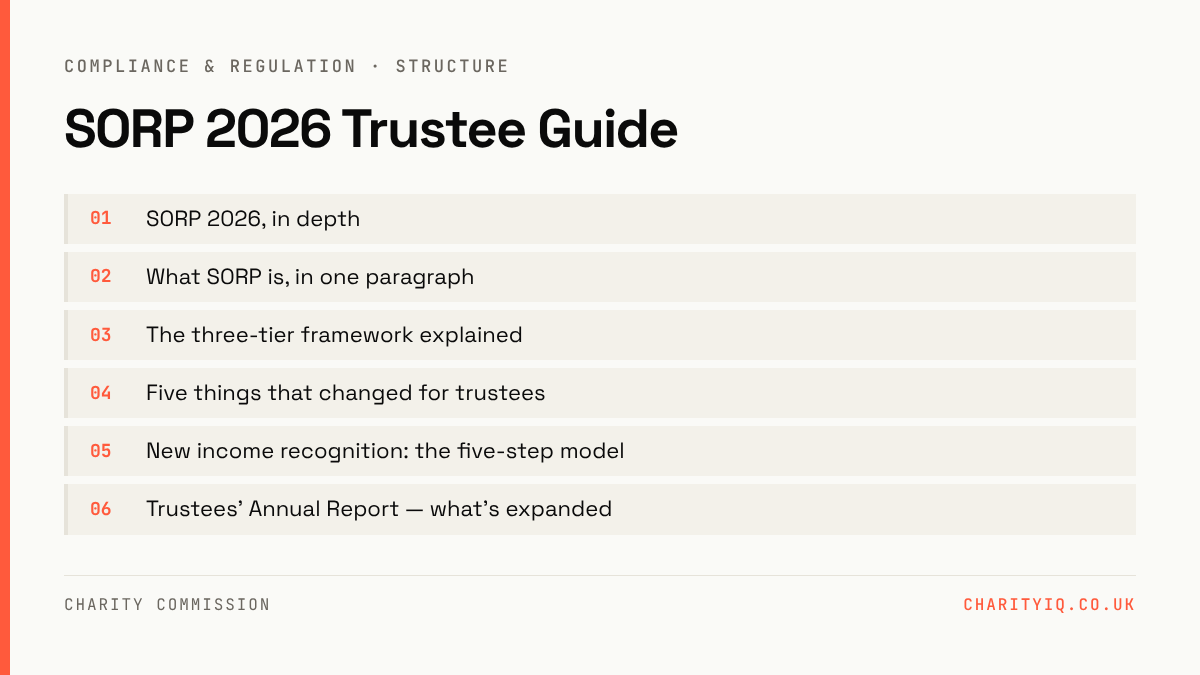
What SORP is, in one paragraph
SORP stands for Statement of Recommended Practice. It’s the document that tells UK charities exactly how to prepare their accounts and trustees’ annual report. It’s issued jointly by the Charity Commission for England and Wales, the Office of the Scottish Charity Regulator (OSCR), and the Charity Commission for Northern Ireland (CCNI), aligned with the UK Financial Reporting Council’s accounting framework (FRS 102). When SORP updates, every UK charity that prepares accruals accounts is affected.
SORP 2026 supersedes SORP 2019 (FRS 102). It was published on 31 October 2025 (Charity Commission announcement).
The three-tier framework explained
The defining feature of SORP 2026 is the move to a tiered reporting framework. Charities are placed into one of three tiers based on gross annual income, and each tier has its own level of disclosure expectation.
Tier 1 — Income up to £500,000
Most UK charities sit in Tier 1. The framework here is explicitly proportionate — fewer narrative requirements, simpler financial disclosures, fewer mandatory analyses.
What Tier 1 means in practice:
– You can present income and expenditure by natural classification (e.g., “donations”, “grants”, “trading income”) rather than the more complex breakdown by activity required at higher tiers
– Reduced disclosure on cost analysis
– Simpler reserves narrative
– No mandatory cash flow statement
– Standard Trustees’ Annual Report (with the new impact requirements — see below)
If your charity has an annual income under £500,000, you’re a Tier 1 charity. This covers the great majority of UK charities — roughly 62% of the sector (Charity Commission sector data).
Tier 2 — Income £500,000 to £15 million
The middle tier. SORP 2026 deliberately keeps this band lighter than full Tier 3 reporting.
Tier 2 charities must:
– Present income and expenditure by activity (the more detailed analysis)
– Provide more granular cost breakdowns
– Disclose detailed reserves analysis
– Comply with all Tier 1 requirements plus expanded narrative
Tier 2 charities are not required to produce a full statement of cash flows unless mandated under FRS 102 directly. This is one of the more substantive easements introduced by SORP 2026 — under the previous SORP, more charities had to produce cash flow statements.
Tier 3 — Income over £15 million
The largest UK charities. Full disclosure regime.
Tier 3 charities must:
– Produce a mandatory statement of cash flows
– Provide expanded narrative on sustainability (social, environmental, governance / ESG) impact
– Detailed analysis of volunteer contribution
– Comprehensive reserves disclosure
– Risk management framework disclosed
Less than 1% of UK charities are Tier 3 (Charity Commission sector data) — but they account for the majority of sector income.
Five things that changed for trustees
These are the changes most likely to affect how trustees experience the annual reporting cycle.
1. Trustees’ Annual Report needs more narrative on impact
Under SORP 2026, all charities (including Tier 1) must include a clear narrative on the impact of their work — not just the activities undertaken, but the difference made for beneficiaries.
This is a meaningful shift from previous SORPs. Previously, impact reporting was good practice but optional. Now it’s expected.
Practical implication: trustees need to be able to articulate, in plain English, what changed for the people their charity serves. If your charity hasn’t been collecting outcome data, the new SORP makes a stronger case for starting.
2. Volunteer contribution becomes a required disclosure
A new explicit requirement: charities must disclose the contribution of volunteers in their Trustees’ Annual Report. This includes (where reasonably calculable) volunteer hours, types of work undertaken, and the value volunteers add.
For small charities run mostly by volunteers, this is significant — your trustees and helping hands are now formally part of the public reporting.
3. Reserves narrative must reconcile to the accounts
A practical fix to a long-standing problem. Previously, charities sometimes stated a reserves position in their narrative that didn’t match the figure in their accounts. SORP 2026 requires the reserves figure in the trustees’ report to reconcile to the figure in the accounts, with any differences explained.
If your charity has a reserves policy stated as “three months’ running costs” but the actual balance differs, the report must explain why.
4. Plans for the future are no longer optional
Previously, including a forward-looking section was good practice. SORP 2026 makes future plans mandatory at all tiers — what the charity plans to do, why, and what resources it expects to need.
For trustees this means engaging with strategy in a documented way at least annually. Many small charities will need to formalise what was previously informal trustee discussion into written board-approved plans.
5. Tier 3: ESG / sustainability narrative
Mandatory only for Tier 3 charities. ESG (environmental, social, governance) reporting now joins financial reporting. Tier 1 and Tier 2 charities are encouraged but not required.
If you’re a small charity, you can ignore this section. If you’re a £15m+ charity, your sustainability reporting framework needs urgent attention.
From CharityIQ
Identifying your tier is the first step. Drafting the new narrative sections — impact, volunteers, reserves reconciliation, future plans — is the second.
CharityIQ pulls your live charity data into a tier-aware draft Trustees’ Annual Report. Trustees review and approve, rather than starting from a blank template. See how it works.
New income recognition: the five-step model
This is the most technical change in SORP 2026 and the one most likely to need professional accountancy advice. The summary below is a starting point, not a substitute for that advice.
SORP 2026 introduces a five-step model for income recognition on exchange transactions — situations where the charity provides goods or services of approximately equal value in return for income (e.g., charging for a course, contracting to deliver a service to a local authority, selling tickets to an event).
The model derives from updated FRS 102 Section 23 (UHY UK on SORP 2026 income recognition).
Exchange vs non-exchange — the key distinction
Exchange transactions = roughly equal value flows in both directions. Examples: charging £30 for a children’s holiday club place, contracted services to a council, gift shop sales.
Non-exchange transactions = the charity receives without giving roughly equal value back. Examples: donations, fundraising income, most grants from foundations.
For non-exchange income (donations, most foundation grants), the previous accounting principles broadly continue. For exchange income (contracts, fees, sales), the new five-step model applies.
The five steps, in plain language
For each exchange contract:
1. Identify the contract — what is the charity formally agreeing to?
2. Identify the performance obligations — what specific deliverables make up the contract?
3. Determine the transaction price — total amount the charity will receive
4. Allocate the transaction price to each performance obligation
5. Recognise revenue as each obligation is satisfied
If a charity is paid £30,000 in advance to deliver a 12-month programme, under the new model that £30,000 is recognised gradually as the programme is delivered, not all in month one. This pattern was already broadly the case under SORP 2019, but the formal five-step framework adds rigour.
Practical implication for small charities
Most charities under £100k income do little exchange-transaction income — most of their income is donations, fundraising, and foundation grants (all non-exchange). The five-step model touches you minimally.
Charities with delivery contracts (especially with local authorities or NHS trusts), trading subsidiaries, or substantial fee income should ask their accountant specifically how SORP 2026 changes their income recognition timing.
Trustees’ Annual Report — what’s expanded
Under SORP 2026, the Trustees’ Annual Report has a refreshed section structure. The standard sections remain — but with expanded expectations within them.
| Section | What’s expanded |
|---|---|
| Reference and admin information | Largely unchanged — charity name, registration, trustees, registered office, advisers |
| Objectives and activities | Clearer narrative expected on charitable objects and how activities serve them |
| Achievements and performance | Major change — explicit impact narrative now required for all tiers |
| Financial review | Reserves figure must reconcile to accounts; any policy variation explained |
| Plans for the future | Now mandatory — what the charity plans, what it’ll cost, why |
| Structure, governance, management | Volunteer contribution disclosure now required; risk management for higher tiers |
Length expectations are not formally set, but for Tier 1 charities a Trustees’ Annual Report under SORP 2026 will typically be 6–12 pages. Tier 2 reports run to 15–25 pages. Tier 3 reports often exceed 50.
When does this apply to your charity?
SORP 2026 applies to accounting periods that start on or after 1 January 2026. This means:
- Charities with a 31 December year-end: SORP 2026 first applies to your 2026 accounts (year ending 31 December 2026), filed by 31 October 2027.
- Charities with a 31 March year-end: SORP 2026 first applies to your year ending 31 March 2027, filed by 31 January 2028.
- Charities with a 30 June year-end: SORP 2026 applies to year ending 30 June 2027, filed by 30 April 2028.
Filing deadline rule: trustees’ annual report and accounts must be filed with the Charity Commission within 10 months of the end of the financial year. Source: gov.uk — prepare a charity annual return.
A 30-minute trustee checklist
For a Tier 1 charity, the practical preparation is straightforward. A board can work through this in a single meeting.
- Confirm your tier. Income under £500k → Tier 1. £500k–£15m → Tier 2. Over £15m → Tier 3.
- Read the impact narrative requirement. Identify what your charity changes for beneficiaries and start collecting evidence if you don’t already.
- Document volunteer contribution. Hours, roles, value. Ballpark is fine for first year — refine over time.
- Reconcile your reserves narrative. Make sure the policy stated in the report matches the actual balance, with any difference explained.
- Write a future-plans section. What will the charity do next year? What resources are needed? Trustee-approved.
- Talk to your accountant. Even Tier 1 charities should confirm exchange/non-exchange treatment for any contract or fee income.
- Update your trustees’ meeting agenda. Add SORP 2026 readiness as a standing item until the first set of accounts is filed.
What to do next
If you’re a trustee, two practical actions:
1. Confirm your tier and your filing deadline. Check the income band and the year-end date. Pin the deadline to your trustees’ meeting agenda.
2. Start drafting impact narrative. This is the single biggest narrative change for Tier 1 charities. Don’t wait until accounts time — outline it now, refine through the year. The richer your data, the easier the eventual write-up.
For charities that want help drafting the new SORP 2026 Trustees’ Annual Report — pulling together impact narrative, reserves analysis, future plans — that’s exactly what we built CharityIQ for. The platform pulls your live charity data into a tier-aware draft, identifies gaps, and structures the narrative to SORP 2026 sections. Trustees review and approve, rather than starting from a blank template.
Ready for SORP 2026 without the spreadsheet panic?
Start a free 14-day CharityIQ trial. Tier-aware drafts. Audit trail by default.
Start free trial →
Frequently asked questions
For accounting periods starting on or after 1 January 2026. If your year-end is 31 March 2026, SORP 2019 still applies — SORP 2026 first applies to your year ending 31 March 2027. Most accountants will confirm which standard applies.
Tier is set by gross annual income. Tier 1 (under £500k) = simplified reporting. Tier 2 (£500k–£15m) = expanded disclosures. Tier 3 (over £15m) = full disclosure including mandatory cash flow statement and ESG narrative. Most UK charities are Tier 1.
For accruals accounts, yes — your accountant should be familiar with SORP 2026. For receipts-and-payments accounts (allowed for small charities under £250,000 income with no auditing requirement), the SORP framework is less directly relevant. The threshold for SORP-compliant accounts has now doubled from £250,000 to £500,000 in England and Wales — meaning more small charities can use simpler accounting (UK Government — accounting regime change).
All tiers must include impact narrative, volunteer contribution disclosure, reserves reconciliation, and future plans. Tier 3 adds ESG/sustainability reporting. Most existing reports already include some of this — under SORP 2026 it becomes mandatory.
Most foundation grants are non-exchange transactions and are not subject to the five-step model. The new model applies primarily to contracts where the charity delivers services in exchange for income (e.g., delivery contracts with local authorities, trading subsidiary income). Restricted grants follow existing rules with some refinement. Speak to your accountant for any contract worth over £10,000.