SORP 2026 Income Recognition: The Five-Step Model Explained
SORP 2026 introduces a five-step model for recognising income from exchange transactions — where a charity provides goods or services of roughly equal value in return — aligned with the updated FRS 102 Section 23. Such income from contracts, fees and sales is recognised as it is delivered, spread across the life of the contract, not when the cash arrives. Non-exchange income, including donations, fundraising and most foundation grants, is largely unchanged. Charities with delivery contracts or trading are most affected and should review with their accountant.
The short answer
SORP 2026 changes when you recognise certain income, not how much you receive. It splits income into two types. Non-exchange income — donations, fundraising, and most foundation grants — follows broadly the same rules as before: you recognise it when you’re entitled to it, it’s probable you’ll receive it, and you can measure it reliably. Exchange income — contracts, fees, and sales, where you provide something of roughly equal value in return — now follows a five-step model and is recognised as you deliver, spread across the life of the contract rather than booked up front.
Exchange vs non-exchange — the distinction that decides everything
Before the five steps matter, you need to know which of your income is even affected. SORP 2026 hinges on one question: does your charity give something of roughly equal value in return for the money?
| Income type | What it means | Examples | SORP 2026 treatment |
|---|---|---|---|
| Non-exchange | You receive without giving roughly equal value back | Donations, legacies, fundraising income, most foundation/trust grants, most government grants | Largely unchanged — recognise on entitlement, probability, measurability |
| Exchange | You provide goods/services of roughly equal value in return | Service-delivery contracts with a council or NHS body, course/training fees, ticket sales, gift-shop and trading income, room hire | New five-step model applies |
The single most important takeaway: most small-charity income is non-exchange and is not subject to the five-step model. If you’re funded by grants and donations, you can relax. If you hold contracts or trade, read on.
The five-step model, in plain language
For each exchange contract, SORP 2026 (following FRS 102 Section 23) asks you to work through five steps:
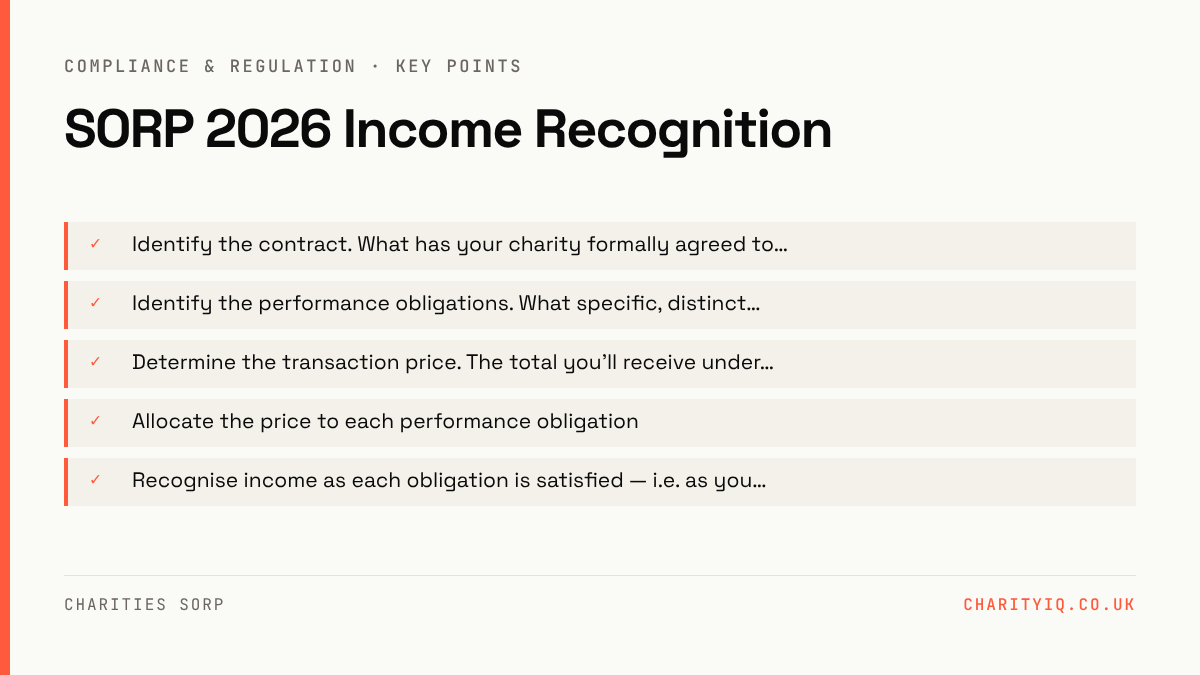
- Identify the contract. What has your charity formally agreed to — with whom, for what, over what period?
- Identify the performance obligations. What specific, distinct things have you promised to deliver?
- Determine the transaction price. The total you’ll receive under the contract.
- Allocate the price to each performance obligation.
- Recognise income as each obligation is satisfied — i.e. as you actually deliver.
The shift from previous practice is mostly in steps 2, 4 and 5: you break a contract into what you’ve promised, and you recognise the money as you deliver each part, rather than all at once when you sign or get paid.
A worked example
Riverside Youth Trust (a fictional Tier 1 charity) signs a £36,000 contract with its local authority to run a 12-month youth mentoring programme, paid in advance in April.
- Under a naïve “cash-in” approach, it might book all £36,000 as income in April.
- Under SORP 2026’s five-step model, the performance obligation (delivering mentoring) is satisfied steadily across the year, so income is recognised at roughly £3,000 per month. At its 31 December year-end, it recognises 9 months (£27,000) as income and carries the remaining £9,000 as deferred income (a liability) into the next year.
The total is identical — £36,000. The timing is what the model controls, and it gives a truer picture of the year’s activity. (For a grant of £36,000 from a foundation with no service in return, this model would not apply — that’s non-exchange income.)
How your common income types are treated
| Income | Exchange or non-exchange? | Typical SORP 2026 treatment |
|---|---|---|
| Individual donations & fundraising | Non-exchange | Recognise when entitled, probable, measurable (as before) |
| Foundation / trust grants | Non-exchange (usually) | Recognise on entitlement; restrictions tracked as restricted funds |
| Government / local-authority grants | Non-exchange (usually) | As above — a grant, not a contract |
| Local-authority / NHS service contracts | Exchange | Five-step model — recognise as delivered |
| Training, courses, event tickets | Exchange | Five-step model — recognise as delivered |
| Trading subsidiary / shop income | Exchange | Five-step model |
| Membership subscriptions | Depends on what members get | Judgement — ask your accountant |
| Legacies | Non-exchange | Recognise when receipt is probable and measurable |
From CharityIQ
The hard part isn’t the five steps — it’s knowing which of your income lines is exchange vs non-exchange, and tracking restricted funds correctly alongside it.
CharityIQ’s compliance module flags how each income type maps to SORP 2026 and keeps the audit trail behind every figure. Trustees review and approve. See how it works.
Restricted grants: a quick clarification
Restricted foundation grants are still non-exchange income — the five-step model doesn’t apply just because money is restricted. Restriction affects which fund the income sits in (restricted vs unrestricted), not whether it’s exchange income. You recognise a restricted grant when you’re entitled to it, then spend it within its restriction. The exception is where a “grant” is really a contract for services dressed up in grant language — substance over form decides, so check the agreement’s terms.
Does this affect small charities?
For most charities under £100,000 income: minimally. Their income is overwhelmingly donations, fundraising and foundation grants — all non-exchange. The five-step model is something to understand, not fear.
You should specifically review income recognition with your accountant if your charity:
- holds service-delivery contracts with a local authority, NHS body, or similar;
- earns significant fee income (courses, training, consultancy);
- runs a trading subsidiary, shop, or events programme; or
- receives money described as a “grant” that actually requires you to deliver specific services in return.
What to do next
- List your income lines and tag each as exchange or non-exchange using the table above.
- Flag every contract and fee to your accountant for the five-step model and deferred-income treatment.
- Check any “grant” that requires you to deliver services — it may be an exchange contract.
For charities that want each income line mapped to SORP 2026 with the working shown, that’s exactly what we built CharityIQ for.
Ready for SORP 2026 without the spreadsheet panic? Tier-aware drafts. Audit trail by default. Start free trial →
- SORP 2026: A Trustee’s Plain-English Guide
- SORP 2026 vs SORP 2019: Every Change Explained
- What Tier Is Your Charity? SORP 2026 Tier Checker
This article is general guidance, not accounting advice. Confirm your charity’s income treatment with a SORP-aware accountant.
Frequently asked questions
Usually no. Most foundation and government grants are non-exchange income and keep broadly the same treatment. The five-step model applies to exchange transactions — contracts, fees and sales — where you deliver services of roughly equal value in return.
In an exchange transaction you give goods or services of roughly equal value in return for the money (a council service contract, course fees). In a non-exchange transaction you don't (a donation, most grants). Only exchange income uses the five-step model.
It depends on the agreement. If you must deliver specified services in return, it may be an exchange contract; if it's funding toward your charitable aims without a service in return, it's a grant (non-exchange). Substance over form decides — check the terms with your accountant.
Not the total — it changes the timing. Exchange income paid in advance is recognised as you deliver, with the undelivered portion carried as deferred income.
For accruals accounts with any contract or fee income, yes — confirm your treatment with a SORP-aware accountant. Charities on receipts-and-payments accounts are affected far less.