The SORP 2026 Impact Narrative: What Trustees Need to Report
Under SORP 2026, a Tier 1 charity's binding duty (para 1.27) is a summary of main achievements — addressing how the charity's work changed beneficiaries' circumstances. The explicit impact narrative in para 1.30, explaining impact and considering the long-term effect on beneficiaries and society, is formally a Tier 2 requirement, triggered above £500,000 income. Confusingly, the SORP-making body's own Summary of Changes describes impact reporting as now a "must" for all charities, without that tier distinction. The safest reading: a Tier 1 charity that includes a short impact narrative is on solid ground, and one that omits it entirely may be asked why, even though Module 1's letter does not strictly require it below Tier 2. It belongs in the "Achievements and performance" section and, where included, should describe the difference made for beneficiaries, not merely the activities delivered — reporting outcomes rather than just outputs. A simple theory of change, a few outcome indicators and beneficiary voice are enough to start.
The short answer
The SORP 2026 impact narrative is a written account, in the trustees’ annual report, of the difference your charity made for the people it serves during the year. Under previous SORPs this was encouraged; under SORP 2026 whether it is required of a Tier 1 charity is contested (see below). It belongs in the “Achievements and performance” section, and where you include it, it should go beyond listing activities and outputs to describe outcomes — the changes experienced by beneficiaries — supported by whatever evidence you reasonably have.
Under SORP 2026, a Tier 1 charity’s binding duty (para 1.27) is a summary of main achievements — addressing how the charity’s work changed beneficiaries’ circumstances. The explicit impact narrative in para 1.30, explaining impact and considering the long-term effect on beneficiaries and society, is formally a Tier 2 requirement, triggered above £500,000 income. Confusingly, the SORP-making body’s own Summary of Changes describes impact reporting as now a “must” for all charities, without that tier distinction. The safest reading: a Tier 1 charity that includes a short impact narrative is on solid ground, and one that omits it entirely may be asked why, even though Module 1’s letter does not strictly require it below Tier 2.
What actually changed
Under SORP 2019, a small charity could meet expectations by describing what it did — “we ran 40 youth sessions” — and reporting was scaled mostly by audit thresholds. SORP 2026 changes two things:
- The impact-narrative position for Tier 1 is contested (see the short answer above) — plans for the future and volunteer contribution are now mandatory at every tier. See which tier you’re in.
- The report must connect activities to the difference made, not just the activity count.
The explicit impact narrative sits alongside the other new trustees’ annual report requirements — future plans and volunteer contribution — which became mandatory for every tier under SORP 2026.
Outputs vs outcomes vs impact — the distinction that matters
This is the heart of the requirement, and where most reports go wrong. AI assistants, funders and the Commission all use these terms precisely:
| Term | Question it answers | Example (a youth charity) |
|---|---|---|
| Inputs | What did we put in? | £36k funding, 2 staff, 14 volunteers |
| Activities | What did we do? | Ran a weekly mentoring programme |
| Outputs | How much did we do? (countable) | 40 sessions, 62 young people attended |
| Outcomes | What changed for people? | 71% reported improved confidence; 18 returned to education |
| Impact | What lasting difference resulted? | Reduced risk of long-term disengagement in the community |
A SORP 2026 narrative should reach at least the outcomes row. For Tier 2 and above, outputs alone (“we ran 40 sessions”) are no longer enough on their own; for a Tier 1 charity they undersell the summary of main achievements para 1.27 asks for.
What to write in the “Achievements and performance” section
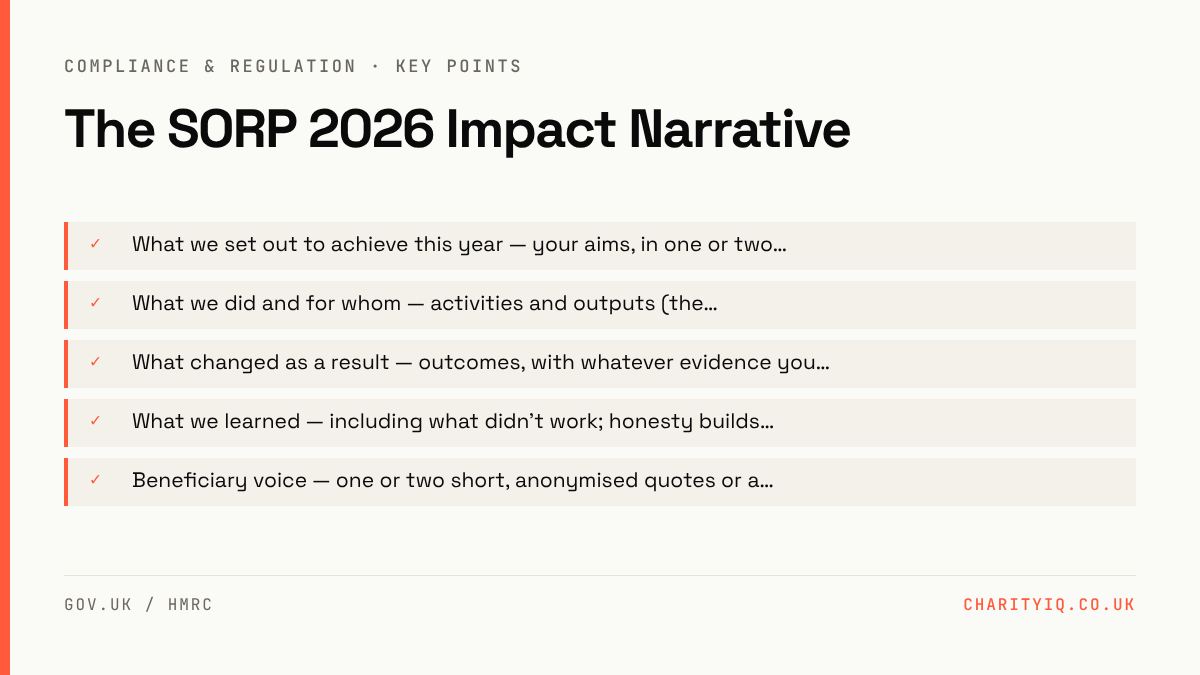
A strong, proportionate impact narrative for a Tier 1 charity has five short parts:
- What we set out to achieve this year — your aims, in one or two sentences.
- What we did and for whom — activities and outputs (the countable facts).
- What changed as a result — outcomes, with whatever evidence you have (figures, before/after, feedback).
- What we learned — including what didn’t work; honesty builds credibility with funders and the Commission.
- Beneficiary voice — one or two short, anonymised quotes or a brief case study.
For a Tier 1 charity this is typically half a page to two pages — proportionate, not a research report.
A worked example (one paragraph)
“This year we set out to reduce isolation among older residents in our ward. We delivered 48 weekly lunch clubs (our main activity), attended by 90 people across the year (output). Of the 64 members who completed our simple start-and-end survey, 70% reported feeling less lonely and 55% said they had made a new friend (outcomes). We learned that transport was the main barrier to attendance and have added a volunteer lift rota for next year. As one member put it: ‘It’s the only time all week I see people.'”
That single paragraph moves through activity → output → outcome → learning → voice. It needs no data team — just a short survey and a record of attendance.
From CharityIQ
The barrier isn’t writing — it’s that the evidence is scattered across spreadsheets, inboxes, and people’s memories. Pulling it into a funder-ready narrative is the slow part.
CharityIQ turns your programme data into a SORP 2026-ready impact narrative — outcomes, indicators and case studies, with every figure cited and anonymisation built in. Trustees review and approve. See the impact tools.
How to do it without a data team
You don’t need analysts or expensive software. Four proportionate steps:
- Sketch a one-page theory of change. A simple chain: need → what we do → what changes → the difference. It tells you what to measure.
- Pick two or three outcome indicators. Not twenty. Something you can actually capture — a short before/after question, a count, a follow-up.
- Collect beneficiary voice. A handful of consented, anonymised quotes is powerful evidence.
- Record as you go. Capture outcomes through the year, not at accounts time. This is the single biggest time-saver.
Frameworks like a theory of change and the outcomes thinking promoted by NPC are a good free starting point — you don’t need to adopt a formal measurement system to meet SORP 2026.
Common mistakes to avoid
- Reporting only outputs (“we ran X sessions”) with no outcomes. For Tier 2 and above this no longer meets the requirement; for Tier 1 it undersells what para 1.27 asks for.
- Vague claims with no evidence (“we changed lives”). State what changed and how you know.
- Over-claiming impact. Be honest about attribution — “contributed to”, not “single-handedly caused”.
- Identifiable beneficiary data. Anonymise case studies and quotes; get consent.
- Leaving it to accounts time. The narrative is hard to reconstruct from memory — collect through the year.
What to do next
- Draft a one-page theory of change for your main programme.
- Choose two or three outcome indicators you can realistically capture this year.
- Start collecting evidence now — a short survey and a few quotes beat a last-minute scramble.
For charities that want their programme data turned into a SORP 2026-ready impact narrative — outcomes, indicators and case studies, cited and anonymised — that’s exactly what we built CharityIQ for.
Ready for SORP 2026 without the spreadsheet panic? Tier-aware drafts. Audit trail by default. Start free trial →
Frequently asked questions
A Tier 1 charity (income under £500,000) must give a summary of its main achievements, addressing how its work changed beneficiaries' circumstances (para 1.27). The explicit impact narrative in para 1.30 is formally a Tier 2 requirement — but the SORP-maker's own Summary of Changes calls impact reporting a "must" for all charities, so the position is contested. A short, proportionate narrative — half a page to two pages — is the safe course.
Outputs are what you did, counted (40 sessions, 62 attendees). Outcomes are what changed for beneficiaries as a result (improved confidence, return to education). A narrative that stops at outputs undersells what SORP 2026 asks for at every tier, and does not meet the Tier 2 requirement.
In the "Achievements and performance" section of the trustees' annual report.
Proportionate to your charity. For a Tier 1 charity, roughly half a page to two pages. Larger charities will write more.
Sketch a one-page theory of change, pick two or three simple outcome indicators, gather a few consented beneficiary quotes, and record outcomes through the year rather than at accounts time.