Theory of Change vs Logic Model: What Funders Want
A theory of change explains why an organisation's work leads to change, including assumptions and context, and is narrative-led; a logic model shows what an organisation does and in what sequence, usually as a structured diagram. Large funders such as the National Lottery Community Fund often ask for a theory of change, while commissioners and some trusts prefer a logic model. Either can be built from the other in around 30 minutes using free diagramming tools.
The 60-second answer (comparison table)
I look at the theory of change vs logic model question from both sides: as a trustee who writes the grant applications for my own small charity, and as the person who built CharityIQ’s impact templates and tools. Strip the jargon away and the distinction is simple. A theory of change is a narrative and diagram explaining why and how your activities are expected to lead to long-term change, including the assumptions and external factors involved; a logic model is a more structured, usually linear diagram showing inputs, activities, outputs, outcomes and impact in sequence. Most charities benefit from having both, but if you can only build one, a theory of change gives you more to work with when adapting to different funders’ formats. (The wider approach lives in our impact measurement handbook.)
| Theory of change | Logic model | |
|---|---|---|
| Format | Narrative + diagram, often non-linear | Linear diagram or table |
| Shows | Why change happens, including assumptions and context | What you do and in what order |
| Best for | Strategy, complex or long-term programmes | Monitoring plans, funder reporting templates |
| Typical length | 1–2 pages plus diagram | Single-page table or flowchart |
| Common funder ask | National Lottery Community Fund, larger trusts | Local authority commissioners, some trusts |
What a theory of change shows
A theory of change sets out the change you want to see, works backwards to the conditions needed to achieve it, and makes explicit the assumptions linking your activities to that change, including factors outside your control. It typically includes a narrative explanation alongside a visual map, because assumptions and context don’t always fit neatly into boxes and arrows.
Good theories of change name what has to be true for the model to work, for example “young people need at least 10 mentoring sessions to see attendance improve” and flag it as an assumption to be tested, not a guarantee. This is what separates a genuine theory of change from a glorified activity list: it explains the “why,” not just the “what.” I built CharityIQ’s theory of change template to force those assumptions out of your head and onto the page — the part most first drafts skip.
What a logic model shows
A logic model lays out, usually left to right, the inputs (resources), activities (what you do), outputs (immediate, countable results), outcomes (changes for beneficiaries), and impact (longer-term change), in a single structured diagram or table. It’s less concerned with explaining why the links hold and more focused on giving you a clear, monitorable sequence to report against.
| Inputs | Activities | Outputs | Outcomes | Impact |
|---|---|---|---|---|
| Staff, funding, venue | Weekly mentoring sessions | 45 young people attend | Attendance and confidence improve | Reduced NEET rate locally |
Because it’s structured this way, a logic model translates almost directly into a monitoring and evaluation plan: each column becomes something you can count or measure, which is exactly why funders who need standardised reporting tend to prefer it. If deciding what to count is the sticking point, the free outcome indicator picker helps you land on indicators you can realistically collect.
Which one your funder wants (NLCF, trusts, commissioners)
Larger, strategically-minded funders such as The National Lottery Community Fund typically ask applicants to articulate a theory of change, because they’re assessing whether your reasoning about long-term change is sound, not just whether your activities are logical. Local authority commissioners and some trusts with standardised reporting templates more often ask for a logic model, because it’s easier to build a contract monitoring framework directly from one.
Researching funders for CharityIQ’s grant-finder taught me not to trust anyone’s summary of a funder’s preferred format — including mine — so check the live application guidance for the round you’re actually in. If a funder’s application form doesn’t specify which format they want, submit whichever one you have, and offer to translate it into the other on request, since the underlying content overlaps heavily.
From experience: The theory of change vs logic model choice matters less than most charities think — what matters is whether your assumptions are written down anywhere at all. Reading funder guidance while building CharityIQ’s impact tools, I kept seeing the same pattern: assessors skim the boxes and arrows, then slow down at the assumptions, because that’s where weak thinking hides. If you only have one evening, spend it naming the two or three things that must be true for your project to work; the formatting can follow later.
Build one from the other in 30 minutes
Because a theory of change and a logic model draw on the same underlying information, you can convert one into the other quickly rather than starting from scratch each time a funder asks for a different format.
- From theory of change to logic model (about 30 minutes): pull your activities into the “activities” column, your immediate countable results into “outputs,” your stated changes for beneficiaries into “outcomes,” and your long-term change statement into “impact.” Inputs come from your resourcing section.
- From logic model to theory of change (about 30–45 minutes): take each arrow between columns and write a sentence explaining why you believe that link holds, and what would have to be true for it to fail. This is where you surface your assumptions.
Either direction, the exercise is mostly reformatting information you already have. For my own charity’s funding applications I keep one master document and reformat from it each time — which is why I’d build the fuller theory of change first: it’s easier to compress into a logic model than to expand a bare logic model into a persuasive narrative under time pressure.
Worked example, same project both ways
Take a fictional charity running a debt advice service. As a theory of change: “People in problem debt often disengage from support because of shame and complexity. If we offer free, non-judgemental one-to-one advice in accessible community settings, clients will be more likely to engage, and engaged clients are more likely to resolve or manage their debt sustainably, assuming underlying income problems are also addressed alongside advice.”
As a logic model, the same project becomes: Inputs (advisers, venue, funding) → Activities (weekly drop-in advice sessions) → Outputs (120 clients seen per year) → Outcomes (70% of engaged clients reduce problem debt within 6 months) → Impact (fewer local households in problem debt). Same project, same evidence, two different funder-facing formats. For a fuller annotated version, see our worked theory of change example.
See CharityIQ’s impact report how-to for how either format feeds directly into your annual impact reporting, and the impact frameworks compared post if you’re choosing a wider measurement approach.
What to do next
If you don’t have either document yet, my advice is to start with a theory of change, since it forces you to articulate assumptions a logic model can skip over. If you already have one, spend 30 minutes converting it into the other format so you’re ready whichever a funder’s application form asks for.
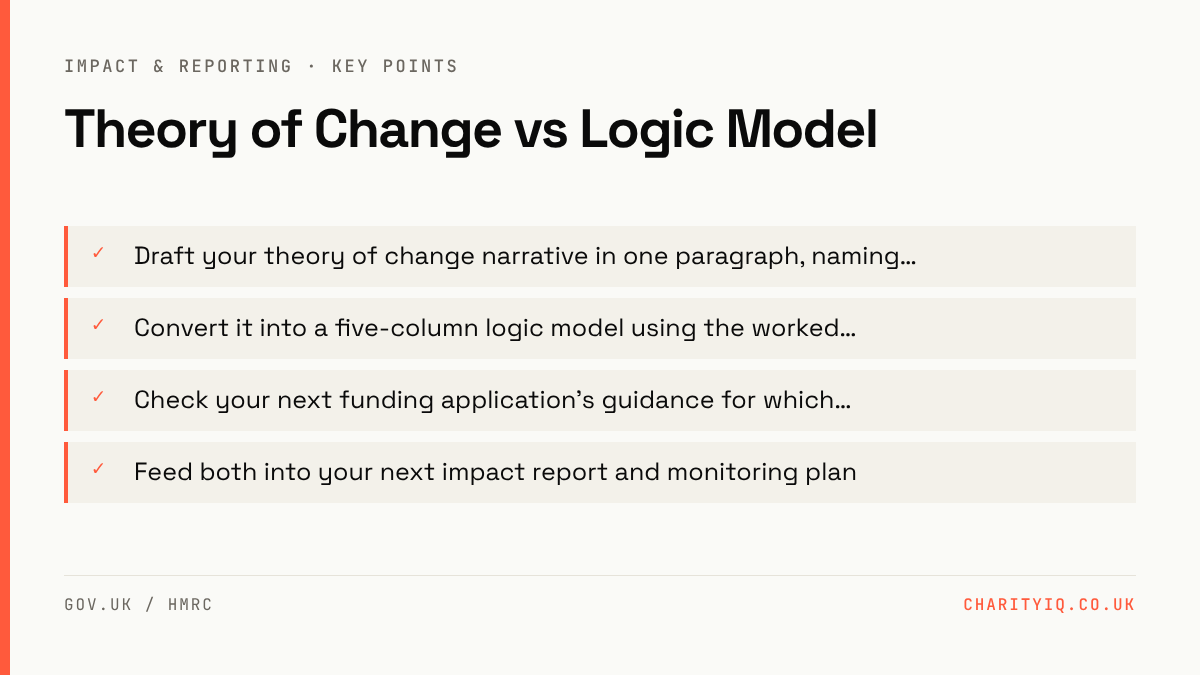
- Draft your theory of change narrative in one paragraph, naming your key assumption.
- Convert it into a five-column logic model using the worked example above as a guide.
- Check your next funding application’s guidance for which format, if any, it specifically requests.
- Feed both into your next impact report and monitoring plan.
Want CharityIQ to help build and maintain both formats from one set of inputs? Join the impact module waitlist →
Frequently asked questions
No. A logic model is a structured, usually linear diagram of inputs through to impact, while a theory of change is a broader narrative explaining why that sequence is expected to work, including assumptions and context. Many charities use both, built from the same underlying evidence.
It depends on the funder. Strategically-minded funders often ask for a theory of change to assess your reasoning; commissioners and some trusts with standardised templates often prefer a logic model. Check the specific application guidance, or prepare both from the same source material.
Even a simple, one-page version of either helps small charities clarify what they're trying to achieve and improves both grant applications and internal monitoring. You don't need a consultant-grade version; a clear, honest one-pager is enough for most funding requirements.
Free tools such as Google Slides, PowerPoint, Canva or Miro are sufficient for most charities; the value is in the thinking, not the software. Specialist theory-of-change software exists but is rarely necessary unless you're managing a very large, multi-strand programme.
Not fully. A logic model shows sequence well but doesn't capture assumptions or context, which is often exactly what a funder assessing strategic risk wants to see. If a funder explicitly asks for a theory of change, a bare logic model alone may be judged incomplete.
Review it whenever your programme design changes significantly, and at minimum annually alongside your impact reporting cycle, so it stays a working tool rather than a one-off document produced for a single funding bid.